


Month-end shouldn't come down to one person squinting at two screens, matching transactions line by line until the numbers finally agree.
For a lot of finance teams, that's exactly what it looks like, and it's usually the reason the books stay behind reality longer than anyone would like.
Bank reconciliation is the fix for that gap. Done well, it's quick and mostly invisible. Done badly, or left until it collides with everything else at month-end, it becomes the bottleneck the whole close waits on.
What is bank reconciliation?
Bank reconciliation is the process of comparing your bank statement against your own accounting records to confirm the two agree, and explaining any differences when they don't.
Two records get compared: the bank's version of your account, and your own ledger.
They rarely match perfectly on any given day. That's not usually a sign something's wrong, it's just timing. A cheque you've recorded might not have cleared yet. A bank charge might have hit your account before you had a chance to log it.
"Reconciled" doesn't mean the two figures are identical. It means every difference between them is accounted for and explained, so the adjusted balances tie out.
Why it matters: Cash accuracy, fraud detection, and audit readiness
Bank reconciliation protects three things every finance team is judged on: an accurate cash position, early fraud detection, and a clean audit trail.
- Cash accuracy. Payment runs, short-term financial forecasting, and spending decisions all rest on your cash position. If that figure is wrong, so is everything built on it.
- Fraud detection. An unauthorised payment or a duplicated transaction shows up fastest against a bank statement that has actually been reconciled, not one assumed to be correct.
- Audit readiness. Auditors want more than a correct closing balance. For a multi-entity group, they want proof it was checked the same way every period, with a trail showing who reviewed what and when.
Why your books and the bank rarely agree: Common reconciling items
Almost every mismatch between your ledger and your bank statement comes down to timing, errors, or fraud. These are the reconciling items to check for:
- Outstanding cheques: Issued and recorded, but not yet cleared by the bank
- Deposits in transit: Received and recorded, but not yet showing on the bank statement
- Bank charges and interest: Applied by the bank before you've recorded them
- Direct debits and standing orders: Taken automatically, sometimes before the matching invoice is logged
- Faster Payments timing: Same-day transfers that hit the bank statement before or after they're posted in the ledger
- Unrecorded entries: A transaction that hasn't been entered yet
- Errors: A transposed figure, a duplicated entry, or a payment posted to the wrong account
- Fraud: An unauthorised or unrecognised transaction that shouldn't be there
Most of these clear on their own within a day or two. The ones that don't are exactly what reconciliation is there to catch.
How to do a bank reconciliation, step by step
A bank reconciliation follows the same seven steps every time, whether you run it monthly or daily:
- Gather your records. Pull the bank statement and your cash book or ledger for the same period.
- Agree opening balances. Check that the opening balance on both records matches the closing balance from your last reconciliation.
- Match line by line. Work through both records and tick off every transaction that appears on both.
- List and apply reconciling items. For anything that doesn't match, identify why and record it as a reconciling item.
- Confirm the adjusted balances agree. Add or subtract each reconciling item until both sides land on the same adjusted balance.
- Post the journals. Record any entries the reconciliation showed were missing from the ledger.
- Document it. Note who prepared it, who reviewed it, and when, so there's a clear audit trail if anyone asks later.
The steps don't change as you grow. What changes is who does them: At scale, software runs the matching and flags the exceptions, so your team works step 4 rather than steps 1 to 3.
What a bank reconciliation statement looks like
A bank reconciliation statement is the document that shows the workings: the bank balance, the ledger balance, every reconciling item between them, and the adjusted figure both sides land on.
Worked example (GBP):
Both sides land on £24,960. That's the figure that goes into the accounts.
How often should you reconcile a bank account?
Reconcile at least monthly, and more often as volume and complexity rise. Monthly is the floor, not the target: high-transaction businesses should reconcile weekly or daily, and continuous reconciliation becomes realistic once bank feeds connect directly to your accounting system, because matching happens as transactions land throughout the month.
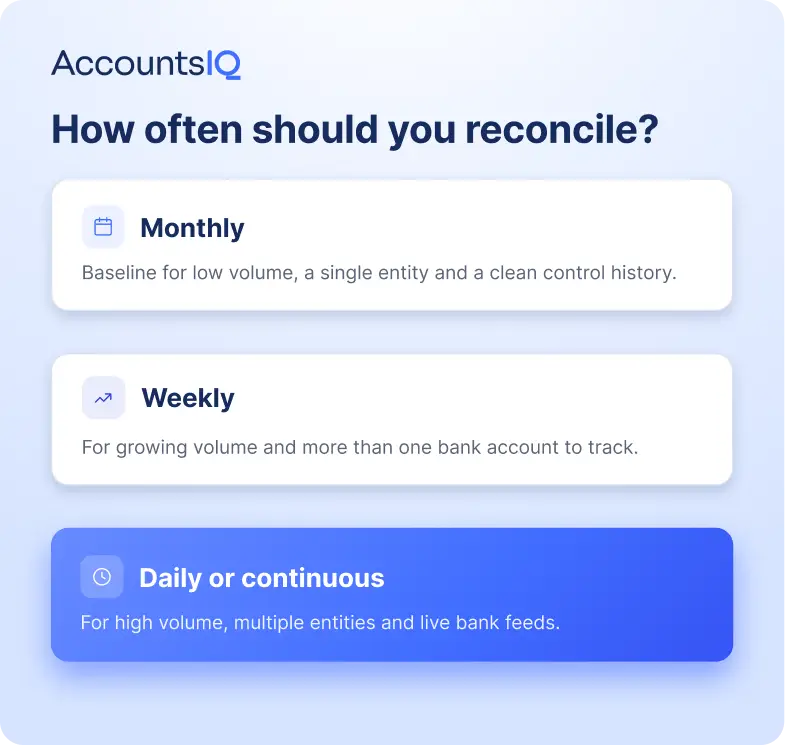
More transactions mean more chances for something to slip through unnoticed, so the busier the account, the shorter the gap between reconciliations should be.
A widely cited APQC survey of 2,300 organisations found top-quartile finance teams complete their monthly close in 4.8 days, against a median of 6.4 days and 10 or more days for the slowest performers. Reconciliation is usually a meaningful part of that gap.
The right frequency comes down to three things:
- Transaction volume: the more you process, the more often you should reconcile.
- Entities and accounts: the more you reconcile across, the more coordination each cycle takes.
- Control history: a record of errors or weaknesses is a reason to reconcile more often.
A single-entity business with low volume and a clean history can often stay monthly. A multi-entity group processing thousands of transactions usually can't.
Bank reconciliation at scale: Multiple entities and currencies
Reconciliation stops being routine the moment you add entities, currencies, and intercompany activity.
A manual monthly task for one set of books becomes a coordination problem across several, and three of those problems are what hold up a group close.
Intercompany reconciliation before you consolidate
Intercompany balances, the money owed between entities in the same group, must net off to zero before you can consolidate.
If entity A shows a receivable from entity B that doesn't match what entity B has booked as a payable, that mismatch flows straight into the group accounts. Leave it until month-end and it holds up the whole close.
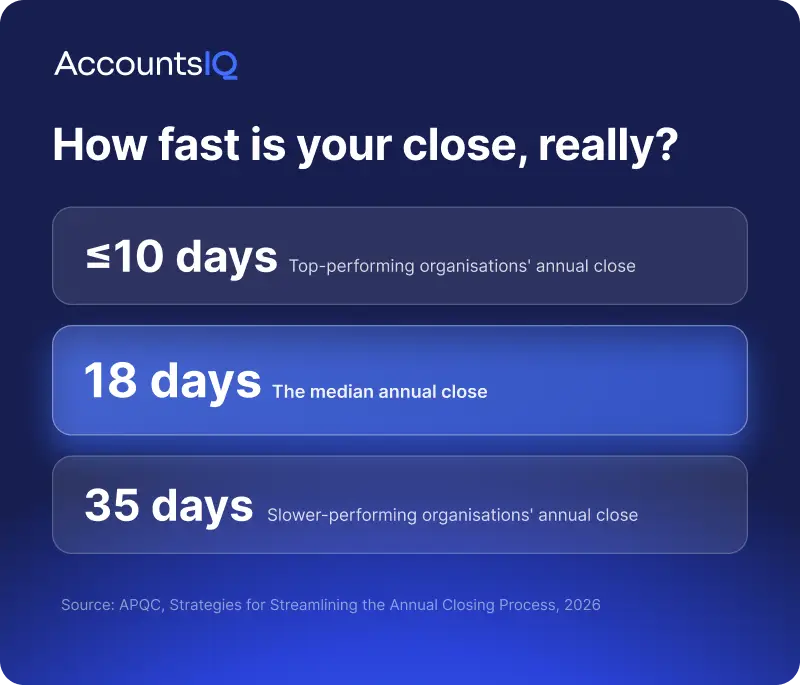
APQC's research on streamlining the annual close found top-performing organisations finish it in 10 days or less, against a median of 18 days and 35 days for slower performers. APQC specifically recommends reconciling intercompany transactions early and reconciling complex accounts monthly, rather than leaving either until year-end.
Multi-currency reconciliation and revaluation
A foreign-currency bank account reconciles against a foreign-currency ledger balance, then gets revalued into your reporting currency at the period-end exchange rate before it can be eliminated at group level.
Skip the revaluation, or use the wrong rate on the wrong date, and the group figures won't tie out even when every entity's own reconciliation is correct.
One consolidated, group-level view
The alternative to an entity-by-entity scramble is a single group-level view: which entities are reconciled, which aren't, and which unreconciled items still need attention.
This is the problem a multi-entity finance platform like AccountsIQ is built to solve.
Bank feeds and configurable matching rules apply the same way across every entity, and group-wide cash visibility rolls the numbers up so you're managing consolidation from one place instead of chasing each set of books in turn.
💡 Book a demo to see how AccountsIQ handles bank reconciliation, consolidation, and reporting across multiple entities and currencies.
Manual or automated: When a spreadsheet stops being enough
Plenty of businesses reconcile perfectly well on spreadsheets. The real question is whether yours still fits the volume and complexity you're dealing with now, or whether it fitted the business you were two years ago.
Signs you've outgrown spreadsheet reconciliation
Spreadsheets rarely fail all at once. You outgrow them gradually, and the strain usually shows up at month-end first. These are the signs worth watching for:
- Matching takes days, not hours. What used to be a quick tick-off has become a job in its own right, and reconciliation turns into the task the whole close waits on.
- You've tacked on entities, accounts, or currencies. The spreadsheet was built for a simpler business, and now one person reconciles several entities in sequence instead of seeing them side by side, so nothing rolls up to a group view without more manual work.
- Version control has become a problem. Multiple copies, overwritten cells, and broken formulas mean you can't always be certain the figures in front of you are the current, correct ones.
- There's no reliable audit trail. When an auditor asks who prepared and reviewed a reconciliation and when, the answer sits in someone's memory or an email thread rather than in the file itself.
- You're rekeying data by hand. Downloading statements and copying transactions across manually eats time and introduces exactly the errors reconciliation is meant to catch.
- The process depends on one person. Reconciliation lives in a single analyst's spreadsheet and their head, so when they're on leave, the close stalls.
Any two or three of these together usually means the volume and structure have moved past what a spreadsheet can safely carry. That's the point where bank feeds and matching rules start to earn their place.
What bank feeds and matching rules actually change
Automated bank feeds pull transactions in directly, and matching rules apply the same logic every time. The accounting software clears the high-confidence majority on its own, so the team only handles the exceptions that need a decision.
That's the shift that matters. Instead of clearing routine matches by hand, reviewers spend their time on the exceptions and judgement calls, the work where their expertise actually counts.
Best practices, and the mistakes that cost you at month-end
A few habits separate a clean reconciliation process from one that causes problems later, and they matter more than they look.
The ACFE's global Occupational Fraud 2026: A Report to the Nations found that more than half of occupational fraud cases involved a lack of internal controls or a management override of them.
Each habit below heads off a specific mistake auditors and finance leaders see again and again:
- Reconcile promptly. Don't let several periods pile up unchecked. The longer a discrepancy sits, the harder it is to trace and the more it can cost: the same report found fraud caught within six months carried a median loss of $40,000, against more than $1.1 million for schemes that ran beyond five years.
- Separate the preparer from the reviewer. The person who prepares a reconciliation shouldn't be the one who signs it off. Self-review is how errors, and occasionally fraud, slip through unnoticed, which is why segregation of duties is a control auditors test for.
- Keep an audit trail. Record who prepared each reconciliation, who reviewed it, and when. A reconciliation with no evidence of review is, to an auditor, a reconciliation that didn't happen.
- Review automated matches, don't rubber-stamp them. Bank feeds and matching rules clear the routine majority, but accepting every suggested match without a look is how a wrong or duplicate entry gets reconciled straight through.
Done consistently, these turn reconciliation into an active control rather than a formality, and the ACFE consistently finds that proactive controls like this are linked to both lower fraud losses and faster detection.
Bank reconciliation and UK compliance: HMRC and Companies House
UK limited companies must keep their accounting records for at least six years from the end of the financial year they relate to, and longer in some cases, such as records covering a transaction that spans more than one accounting period. Fail to keep adequate records and you risk a £3,000 fine from HMRC or disqualification as a company director.
Reconciliation is part of what makes those records stand up. A ledger balance on its own proves nothing. A ledger balance backed by a bank reconciliation, showing it agrees with the bank and marked with who reviewed it and when, is what demonstrates the figures are accurate, and it's the evidence an auditor or HMRC inspector looks for.
The accounts you file at Companies House are built from those same records, so gaps in your reconciliations put accurate filing at risk, not just your internal numbers.
For groups filing consolidated accounts, that audit trail has to exist at every entity, not only the parent. An auditor testing the group accounts can ask to see the underlying reconciliation for any entity, so one unreconciled subsidiary can hold up the whole audit.
Common questions about bank reconciliation
What is the difference between bank reconciliation and account reconciliation?
Bank reconciliation compares your ledger specifically against your bank statement. Account reconciliation is the broader term, covering any balance sheet account, such as accounts receivable, accounts payable or prepayments, checked against its supporting records. Bank reconciliation is one type of account reconciliation.
Does a bank reconciliation have to balance exactly?
Yes, once every reconciling item has been accounted for. The bank balance and the ledger balance don't need to match on the day you look at them, but the adjusted balances, after applying every outstanding item, must agree exactly. If they don't, something's still unexplained.
Who should prepare and review bank reconciliations?
Someone involved in day-to-day transaction processing typically prepares it, and someone independent of that process reviews it. Keeping preparation and review separate is a basic control that catches errors, and occasionally fraud, that a single person working alone would miss.
What happens if you do not reconcile your bank account?
Errors and discrepancies build up unnoticed, cash positions become unreliable and fraud or duplicate payments can go undetected for months. For a UK limited company, it also risks falling short of the record-keeping standards HMRC and Companies House expect.
Can bank reconciliation be fully automated?
Mostly, not entirely. Bank feeds and matching rules can clear the high-confidence majority of transactions automatically. Judgement calls and anything that doesn't fit a standard rule still need a person to review and resolve.