x
Curious about how we compare to Sage50?
Have your questions answered here:
Have your questions answered here:


Your business has grown — has your accounting software kept up? See why finance teams outgrow Sage 50.
“Dimensions are really important to us. We looked at Sage 50, but that only had two dimensions. We needed at least four — AccountsIQ is the only product that lets you create these ‘conditional’ dimensions.”
Who each is for
Growing finance teams hitting the ceiling
Hitting your limits
You're bumping into data, storage or fair usage caps.
More than one entity
You manage multiple entities and need consolidation without manual workarounds.
Prior-year periods open
You need last year's periods open while working in the new year.
A flexible general ledger
You want a chart of accounts and GL that flex as your structure changes.
Open API connections
You want to connect other systems through an open API.
Single-entity, low-volume bookkeeping
One simple entity
You run a single entity with straightforward, low-volume bookkeeping.
Lowest entry cost
You need a low-cost, desktop-based system.
No workflow needs
Your team doesn't require workflow automation or approval routing.
Below the caps
You aren't yet processing volumes that trigger fair usage limits.
Here’s how we compare, feature by feature
| Feature | Sage 50 | AccountsIQ |
|---|---|---|
| Unlimited data storage | Fair usage limits | |
| No fair usage cap on processing | ||
| Multi-dimensional reporting | 2 dimensions | 6 dimensions |
| 3-level GL structure | ||
| Independent period close | ||
| Multi-entity consolidation | Add-on / limited | |
| Automated intercompany eliminations | ||
| Custom integrations by request |
Why finance teams outgrow Sage 50
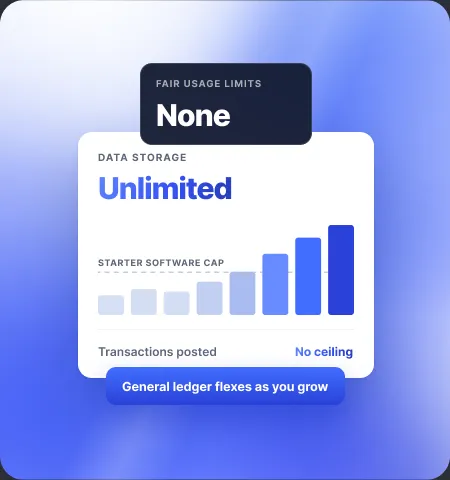
Starter software keeps costs down by limiting storage and processing. AccountsIQ removes the ceiling — unlimited data storage, powerful processing and no fair usage limits, plus a general ledger that flexes as you grow.
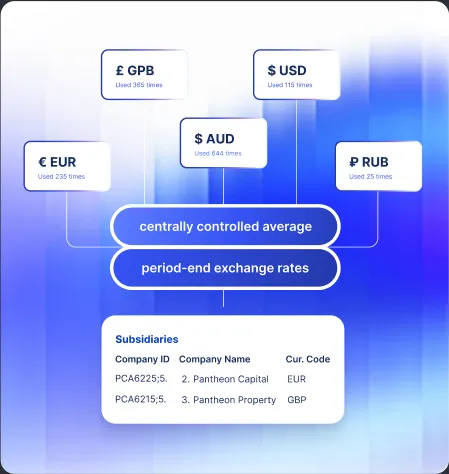
Manage multiple companies and consolidations online, with automated consolidation and the flexibility to keep prior-year periods open. On G2, AccountsIQ's multi-entity capability is rated 8.6 versus Sage 50's 7.5.
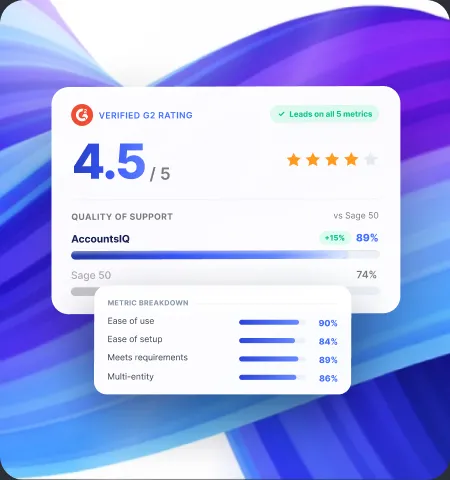
AccountsIQ's Quality of Support is rated 8.9 on G2, well ahead of Sage 50's 7.4. Our support team is 100% UK and Ireland based, with an average first response time of 27 minutes.
Why CFOs switch


What do you like best about AccountsIQ?
AccountsIQ is a robust cloud-based accounting platform that's user-friendly. Implementation is smooth with great onboarding support and the customer service team is responsive and helpful. It’s used daily by our finance team, offering strong features like budgeting and consolidation. The learning academy is a great tool that provides videos and quizzes while transitioning to AccountsIQ which can be taken at your own pace.
See why growing finance teams choose AccountsIQ as their Sage 50 alternative — more room, deeper consolidation and dimensional reporting.
Book a DemoFor growing businesses that need multi-entity consolidation, dimensional reporting and room to scale beyond entry-level limits, AccountsIQ is a leading Sage 50 alternative.
AccountsIQ removes the storage, processing and fair usage limits of entry-level software. It adds multi-entity consolidation, six reporting dimensions and a flexible three-level general ledger.
Most switch when they hit Sage 50's limits — data or processing caps, the need to manage more than one entity, or wanting a chart of accounts that adapts as the business changes.
Yes. Multi-entity consolidation is core to AccountsIQ, not an add-on. On G2, AccountsIQ's multi-entity rating is 8.6 versus Sage 50's 7.5.
Yes. Unlike starter software that closes periods in sequence, AccountsIQ lets you keep key prior-year periods open as you move forward.
Timelines vary by complexity and data volume. Our in-house team manages configuration, migration and training through to go-live.
Yes, our support teams are 100% UK and Ireland based, with online training and support resources available any time.

