

.webp)
Managing one set of accounts is hard enough. Managing several entities, each with its own ledger, currency, approvals, reporting requirements, and month-end timetable, is an entirely different job.
That’s where standard accounting software starts to creak.
For finance teams running groups, subsidiaries, acquired businesses, franchises, or international entities, the issue is rarely basic bookkeeping. It’s consolidation, intercompany, currency translation, group reporting, audit trail, and getting reliable numbers to leadership before the month is already old news.
This guide compares three common routes for UK finance teams:
Note: This is not an exhaustive list of every accounting system on the market. It’s a practical comparison of three common routes finance teams consider as they move from simple accounting to group-level finance management.
How we evaluated the best multi-entity accounting software
We compared each option against the finance requirements that usually create multi-entity pain:
- Can each entity keep its own accounting records?
- Can group finance consolidate without rebuilding reports in spreadsheets?
- Does the system support multi-currency accounting and FX handling?
- How does it handle intercompany postings and eliminations?
- Can finance report at both entity and group level?
- Does the system fit the likely size and complexity of the business?
- Is it a finance system, a full ERP, or a lightweight accounting tool?
Entity count alone doesn’t tell the full story.
A group with three entities, two currencies, and regular intercompany recharges may need more capability than a group with ten standalone entities using the same currency and chart of accounts.
Multi-entity accounting software comparison
The three options below represent the main routes available to finance teams at different stages of complexity:
- A purpose-built mid-market platform
- A full ERP system
- A lightweight cloud accounting tool
Quick comparison table
1. AccountsIQ: Best fit for growing mid-market groups
Best for: UK finance teams managing multiple entities, currencies, subsidiaries, funds, franchises or acquired businesses, where consolidation and group reporting have become too complex for entry-level software.
AccountsIQ is a cloud accounting platform built for organisations that have outgrown basic accounting software but don’t necessarily need the scale, cost, or implementation footprint of a full ERP.
Its strength is that multi-entity accounting is part of the core structure. Finance teams can manage entity-level accounting while producing group-level reporting from the same platform. AccountsIQ supports consolidation across multiple entities and currencies, group reporting, centrally managed FX, intercompany handling, and local-to-group chart of accounts mapping.
Key features:
- Multi-entity accounting across companies, locations, and currencies
- Multi-currency accounting and FX handling
- Intercompany transaction controls
- Entity-level and group-level reporting
- Real-time dashboards and BI reporting
- Open API and integrations with wider business systems
Where it may not fit:
AccountsIQ is unlikely to be the right choice for every business. If you have one company, one currency and straightforward reporting, it may be more capability than you need.
If your organisation needs finance, procurement, inventory, supply chain, HR, and CRM in one system, a full ERP may be more appropriate.
💡 Book a demo to see how AccountsIQ handles consolidation, intercompany, and group reporting for your structure.
2. NetSuite: Best fit for larger ERP requirements
Best for: Larger organisations that need multi-entity accounting as part of a wider ERP system.
NetSuite is typically considered when finance is only one part of a broader systems challenge.
If the business needs a single platform for finance, procurement, inventory, CRM, e-commerce, supply chain, or other operational processes, an ERP system may make sense.
For multi-entity finance teams, the appeal is breadth. NetSuite can support complex group structures, but it usually comes with a larger implementation project and broader change management requirements than a dedicated accounting platform.
Key features:
- Multi-entity and multi-subsidiary structure
- Consolidation and intercompany eliminations
- Multi-currency and multi-language support
- Broad ERP modules including procurement, inventory, CRM, and HR
- Customisable dashboards
- Global tax compliance features
Where it may not fit:
If the main pain is month-end consolidation, intercompany accounting, multi-currency reporting and board packs, a full ERP may be more than the finance team needs. In that case, a purpose-built accounting and consolidation platform may solve the problem with less disruption.
3. Xero: Best fit for small or simple groups
Best for: Small groups or owner-managed businesses that need to manage separate companies but don’t yet have complex consolidation, intercompany, or multi-currency reporting requirements.
Xero is a strong entry-level accounting platform for small businesses and their accountants. It can work well where each company is relatively simple, and group reporting is light, infrequent or handled outside the system.
The challenge comes when the finance team needs more than separate company accounts. Once the group needs recurring consolidation, intercompany eliminations, currency translation, board reporting, or a consistent group chart of accounts, manual work often starts to build around the software.
Key features:
- Separate organisations accessible from one login
- Bank feeds, invoicing, and expense management per entity
- Add-on ecosystem including consolidation tools from third-party providers
- Familiar interface
- Strong accountant and bookkeeper network in the UK
Where it may not fit:
Xero may become harder to manage as entity count, reporting demands, currencies, and intercompany transactions increase. At that point, the finance team may need spreadsheets, add-ons or a move to a system with native group accounting and consolidation.
Which multi-entity accounting software is right for you?
Use this as a quick guide:
When do you need a multi-entity accounting system?
You usually need a dedicated multi-entity accounting system when the workarounds around your current software become part of the month-end process.
A second entity may be manageable. A third might still work with careful spreadsheets. But once consolidation, intercompany transactions, multiple currencies, and group reporting become regular tasks, the risk starts to build.
Here are the signs your finance system is being stretched.
.webp)
1. You’re consolidating entities manually
If month-end means exporting trial balances, adjusting intercompany eliminations in spreadsheets, and checking which file version is the latest, your consolidation process is carrying more risk than it needs to.
In fact, research into operational spreadsheets found errors in 0.8% to 1.8% of formula cells, with some errors having a substantial impact on key spreadsheet outputs.
For a single-entity business, a spreadsheet error may be painful. For a group, it can affect consolidated reporting, board packs, audit queries, and confidence in the numbers.
A multi-entity accounting system helps by keeping entity-level data and group-level consolidation in the same controlled process, instead of forcing finance to rebuild the picture every month.
2. Multiple currencies are adding month-end complexity
Multi-currency accounting is rarely just a currency conversion exercise.
Finance teams may need to manage exchange rates, revalue foreign currency balances, translate entity results into the group reporting currency and explain currency movements clearly to leadership.
When that work sits across spreadsheets or disconnected systems, it becomes harder to check, harder to audit and easier to misstate. The more entities and currencies involved, the more difficult it becomes to maintain consistency.
A dedicated multi-entity system should support currency handling as part of the core accounting process, not as a manual month-end workaround.
3. Intercompany transactions are slowing down the close
Recharges, shared costs, loans, and trading between group companies all create accounting entries that need to match across entities.
If those entries are posted manually, mismatches are almost inevitable. One entity posts a recharge. Another codes it differently. A balance doesn’t agree. Finance then spends time investigating the difference instead of closing the month.
This is one of the clearest signs that the current setup is no longer fit for the group structure. Intercompany activity needs clear posting rules, matching, and elimination – not a spreadsheet maintained by the person who happens to know how it works.
4. Reporting is too slow for leadership decisions
Group finance is often expected to provide board packs, investor updates, and management reports quickly after month-end. But that’s hard to do when the numbers need to be pulled from separate systems, checked manually, and rebuilt into a group view.
The result is all too familiar: finance works hard to produce reports that are already out of date by the time they’re reviewed.
A multi-entity accounting system gives finance a better route to entity-level and group-level reporting from the same source of data, so leadership gets a clearer view without waiting for spreadsheet consolidation to catch up.
5. Spreadsheet workarounds have become business-critical
Spreadsheets aren’t the problem. Most finance teams use them, and for good reason. They’re flexible, familiar, and useful.
The problem starts when spreadsheets become the control layer for consolidation, intercompany eliminations, currency adjustments, and group reporting.
ITPro reported on research showing that nearly nine in ten companies still use Excel to run financial processes. The same research found that data consolidation, data entry, version control, and error management are common frustrations for finance professionals.
That’s the point to watch. If your spreadsheets are no longer supporting the finance system but compensating for it, it may be time to move to dedicated multi-entity cloud accounting software.
6. You’ve outgrown entry-level accounting software
Entry-level accounting tools are built for straightforward accounting. They can work well for single entities and simple company structures.
They start to feel stretched when the business adds subsidiaries, acquires another company, opens entities in new jurisdictions, or begins reporting across multiple currencies.
That doesn’t mean the software is bad. It means the finance requirement has changed.
At that stage, the question is not “can we make the current setup work?” It’s “how much time, risk, and manual checking does it now take to make it work?”
Quick check: Is it time to review your system?
It’s worth evaluating a multi-entity accounting system if three or more of these sound familiar:
- You consolidate entities manually every month
- Intercompany balances regularly need investigation
- Group reporting depends on spreadsheet exports
- Multiple currencies make month-end harder to control
- Leadership waits too long for consolidated numbers
- Audit evidence is spread across systems and files
- Adding a new entity means adding more manual work
If those are regular problems, your finance system may be holding the group back.
What to look for in multi-entity accounting software
The right multi-entity accounting software should do more than let you add another company file. It should give finance a controlled way to manage separate entities, consolidate group results, handle intercompany activity, and report clearly across the business.
Here are the capabilities to look for.
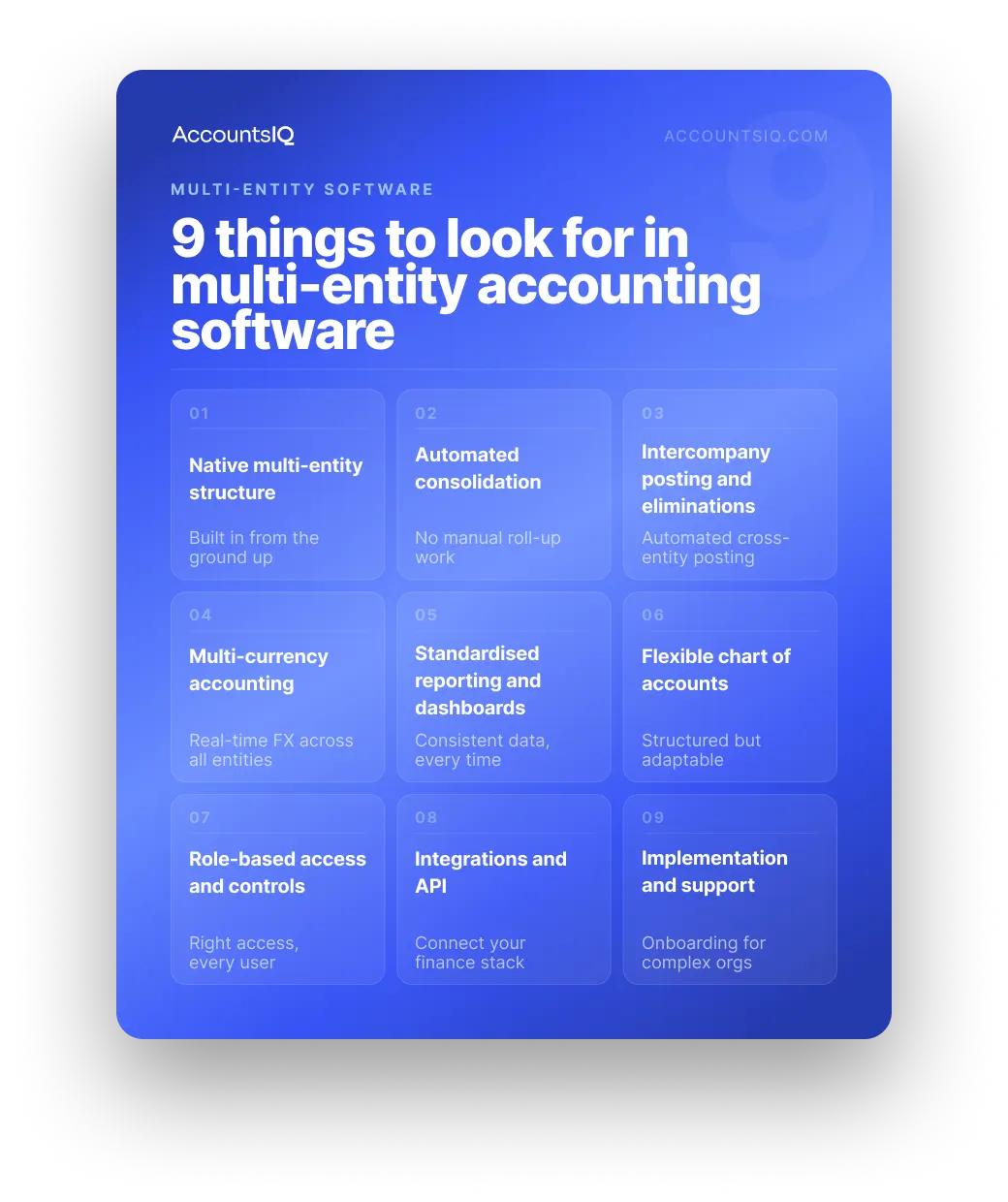
Native multi-entity structure
Each entity should have its own records, controls, and reporting structure, while still sitting inside one group framework.
AccountsIQ is built for multi-entity and multi-currency environments, with each entity able to manage its own books while rolling up into group consolidation. AccountsIQ’s consolidation setup also includes group structure, ownership relationships, and local chart of accounts mapping.
Automated consolidation
Consolidation should happen inside the system, not in a spreadsheet owned by one person.
AccountsIQ supports multi-entity consolidation across groups, subsidiaries, and currencies, helping finance move away from manual spreadsheet-based consolidation and towards a more controlled close process.
Intercompany posting and eliminations
Intercompany transactions need to be easy to post, match and eliminate. Recharges, shared costs, loans and trading between entities can quickly slow month-end if every mismatch has to be investigated manually.
AccountsIQ helps finance manage intercompany activity within the accounting system, so group teams can reduce manual reconciliation work and keep consolidation cleaner.
Multi-currency accounting
If your group operates across the UK, Ireland or internationally, multi-currency accounting needs to be built in. The system should handle exchange rates, revaluation, and translation into the group reporting currency consistently.
AccountsIQ supports multi-currency accounting for groups operating across different currencies, helping finance apply currency treatment more consistently across entities.
Standardised reporting and dashboards
Finance should be able to report at entity level and group level from the same source of data. Look for dashboards, management reports, and drill-down capability that reduce the need to rebuild board packs in Excel.
With AccountsIQ, finance teams can report across entities, departments, and dimensions from one system, giving leadership a clearer view of group performance without waiting for reports to be rebuilt manually.
Flexible chart of accounts and dimensions
A good system should support local entity coding without breaking group reporting. That means local charts of accounts can map to a common group structure, with dimensions such as department, project, region, or cost centre used consistently.
AccountsIQ supports group-level reporting structures while allowing entity-level detail, so finance teams can balance local requirements with consistent group reporting.
Role-based access and controls
Group finance, local finance teams, budget holders, and auditors don’t all need the same access. The software should let you control who can view, post, approve, or report across each entity.
AccountsIQ helps finance teams manage access across a multi-entity structure, so local users can work within their own areas while group finance keeps central visibility and control.
Integrations and API
Multi-entity accounting software needs to connect with the systems around it, from expenses and payroll to CRM, banking, reporting, and operational tools. Integrations reduce rekeying and help keep finance data flowing into the accounting system.
AccountsIQ connects with wider finance and business systems, helping teams bring data into the accounting process without relying on manual uploads and duplicate entry.
Implementation and support
Multi-entity implementation is not just a software setup. The vendor should understand group structures, chart of accounts mapping, currencies, reporting periods, ownership relationships, and consolidation rules.
AccountsIQ works with finance teams to configure the structure behind multi-entity accounting, including entities, reporting requirements, and consolidation processes, so the system reflects how the group actually operates.
💡 Book a demo to see AccountsIQ's multi-entity accounting, consolidation, and reporting capabilities in practice.
How to choose the right multi-entity accounting software
By this point, you should have a good sense of which type of system fits your business: lightweight accounting software, a dedicated multi-entity accounting platform, or full ERP.
The next step is to test each option against how your finance team actually works.
.webp)
1. Start with your non-negotiables
Before looking at demos, agree on what the system must be able to handle from day one.
For most multi-entity finance teams, the non-negotiables are usually:
- Consolidation across entities
- Intercompany activity
- Multi-currency accounting
- Group-level and entity-level reporting
- Chart of accounts flexibility
- Access controls
- Integrations with the wider finance stack
- Implementation support
Keep this list short. If everything is a priority, nothing is.
2. Separate must-haves from nice-to-haves
A long feature list can make every platform look capable. The real question is which features your finance team will rely on every month.
For example, if intercompany transactions slow down every close, intercompany controls should carry more weight than a dashboard-style preference. If board reporting is the main issue, reporting flexibility matters more than peripheral ERP modules.
3. Check whether the system fits your next structure, not just today’s
A system that works for your current entity setup may not work once you add a subsidiary, acquire a business, change reporting lines, or introduce a new currency.
Ask how easy it is to add entities, adapt reporting structures and bring new businesses into the finance process. Growing groups need software that can flex with the structure.
4. Decide whether ERP scope is really needed
Full ERP can make sense if finance is only one part of a wider operational systems problem.
But if the main pressures are consolidation, intercompany accounting, multi-currency reporting, and group visibility, a dedicated multi-entity accounting platform may be a more proportionate fit.
5. Score vendors against weighted criteria
Don’t score every feature equally. Weight each area based on the pressure it creates for your finance team.
The strongest choice is not always the system with the most features. It’s the one that fits your group structure, reduces the most manual work, and gives finance enough control to support the next stage of growth.
💡 AccountsIQ is built for finance teams that need multi-entity accounting, consolidation, intercompany controls, multi-currency support and group reporting without moving straight to full ERP. If those are the issues driving your review, book a demo to see how AccountsIQ maps to your structure and month-end process.
Common mistakes when choosing multi-entity accounting software
Avoid these traps when comparing systems:
- Confusing multi-company access with multi-entity accounting. Managing several company files is not the same as having native consolidation, intercompany controls, and group reporting.
- Buying for today’s structure only. Your system needs to cope with new entities, currencies, acquisitions, and reporting lines as the group changes.
- Leaving process design too late. Chart of accounts mapping, approval flows, reporting dimensions, and intercompany rules should be defined before configuration starts.
- Letting add-ons become the architecture. Add-ons can help, but core consolidation and group reporting should not depend on fragile workarounds.
- Forgetting local users. If local teams find the system hard to use, they will create offline processes that weaken group control.
- Judging success at go-live. The real test is the first close, first consolidation, first board pack, and first audit query.
The best choice is the system that can support how your group works now, and how it is likely to change next.
Multi-entity accounting software FAQs
What is multi-entity accounting software?
Multi-entity accounting software helps finance teams manage multiple legal entities in one system while producing consolidated group reports.
It is used by groups, subsidiaries, franchises, funds, and growing businesses that need separate entity-level accounts alongside group-level reporting. The key difference from basic accounting software is that it supports the extra complexity: intercompany transactions, multiple currencies, entity-level controls, group consolidation, and reporting across the whole organisation.
What is the best multi-entity accounting software?
The best multi-entity accounting software depends on the size and complexity of your group.
For mid-market UK finance teams, AccountsIQ is built for multi-entity accounting, consolidation, intercompany activity, multi-currency accounting, and group reporting.
Can Xero handle multi-entity accounting?
Xero can be used to manage multiple organisations from one login, which may suit small or simple company structures.
However, groups with regular consolidation, intercompany transactions, multi-currency reporting or complex board reporting may need a system with native multi-entity accounting capability. The important question is not whether you can manage multiple companies, but whether you can consolidate and report across them without relying on manual workarounds.
When should a business move to multi-entity accounting software?
A business should consider multi-entity accounting software when manual work starts to pile up around the accounting system.
Common signs include spreadsheet-based consolidation, regular intercompany mismatches, multiple currencies, slow group reporting, audit trails spread across files, or new entities that are difficult to add cleanly. At that point, the issue is control, reporting confidence, and the ability to scale finance as the group grows.