


One missed invoice is an inconvenience. At scale, inefficient invoice processing becomes a finance problem.
In 2025, nearly one in six invoices paid by large UK businesses were late, according to the Department for Business and Trade. Government research also found that 24% of businesses attributed late payments they received to administrative errors, including invoices not being logged correctly.
For finance teams, that can mean more approval chasing, supplier queries, poor visibility, and extra work at month-end.
Here’s where invoice processing tends to go wrong, and what better processes and automation can change.
What is invoice processing?
Invoice processing is the workflow a business follows to receive, check, approve, pay, and record supplier invoices.
It sits within accounts payable (AP), but the two aren’t the same. Invoice processing covers the journey of an individual invoice, while accounts payable is the wider function responsible for managing what the business owes its suppliers.
A good process helps finance make sure invoices are accurate, authorised, coded correctly, paid on time, and backed by a clear audit trail.
Invoice processing also shouldn’t be confused with invoice finance or invoice factoring. Those involve accessing cash against invoices your customers owe you. Invoice processing deals with invoices your business needs to pay.
How does invoice processing work? 7 steps from receipt to payment
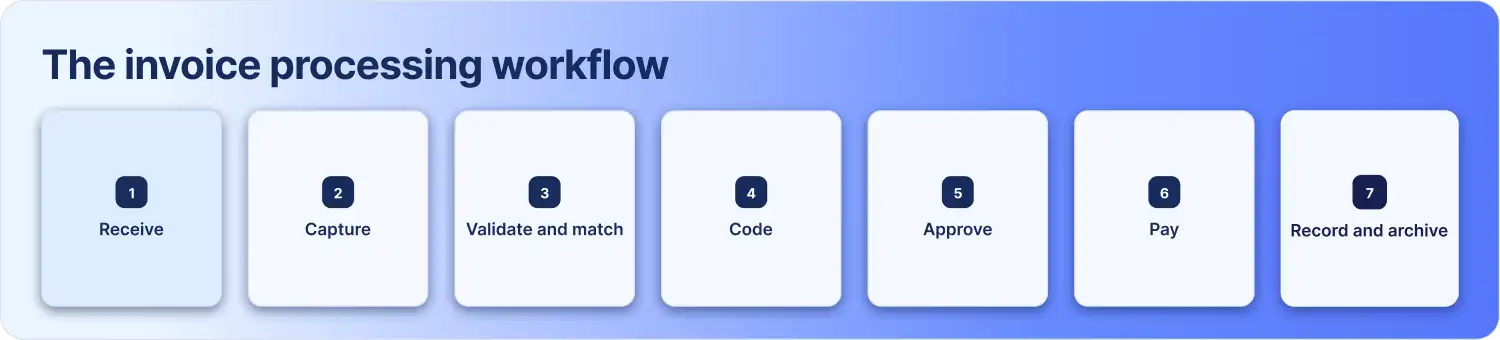
Most supplier invoices move through seven stages:
- Receive: The invoice arrives by email, supplier portal, electronic exchange, or post.
- Capture: Supplier, invoice number, date, amount, VAT, and line-item data are entered into the accounting system.
- Validate and match: Finance checks the invoice against the purchase order and, where relevant, the goods received record.
- Code: The cost is assigned to the right general ledger code, department, project, cost centre, or entity.
- Approve: The invoice goes to the relevant budget holder or approver.
- Pay: Once approved, it’s included in the appropriate payment run.
- Record and retain: The transaction is posted, and the invoice and approval history are retained.
For PO invoices, comparing the purchase order, goods received record, and supplier invoice is known as three-way matching. If the details don’t agree, the invoice can be flagged for review before payment.
PO vs non-PO invoices: why they shouldn’t follow exactly the same path
Not every invoice has a purchase order behind it.
A PO invoice can be checked against an existing purchase order, giving finance a clear reference for what was ordered, at what price, and by whom.
A non-PO invoice, such as rent, utilities, professional services, or a one-off supplier charge, doesn’t have that reference.
That means non-PO invoices need a strong approval process to establish:
- who owns the cost
- whether it was authorised
- how it should be coded
Trying to force PO and non-PO invoices through exactly the same workflow can add delay without adding much control.
Manual vs automated invoice processing
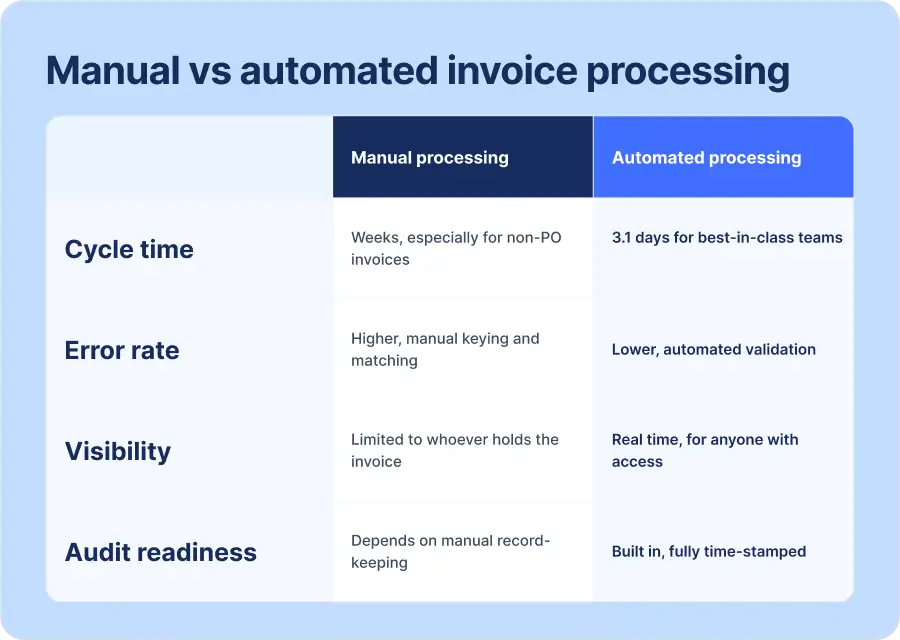
Manual invoice processing creates work at every stage.
Invoices are downloaded, rekeyed, forwarded, matched, chased, corrected, and filed. At higher volumes, those small tasks add up.
Ardent Partners’ AP benchmarking found a marked performance gap between its highest-performing AP teams and other organisations. Its published benchmarks put invoice processing time at 3.1 days for Best-in-Class teams, compared with 17.4 days for all others.
What can invoice automation handle?
Depending on the system, automation can support:
- Data capture: OCR can extract invoice details from PDFs and scanned documents.
- PO matching: Software can compare invoice data with purchase orders and agreed tolerances.
- Approval routing: Rules can send invoices to the right person based on value, supplier, department, project, or coding.
- Exception handling: Mismatches can be flagged for review rather than discovered later.
- Posting and record keeping: Approved invoices can remain connected to their accounting record and approval history.
For finance leaders, that can mean less manual entry, fewer approval chases, earlier visibility of liabilities, more consistent coding, and a clearer audit trail.
Common invoice processing problems
Most AP bottlenecks come back to a handful of recurring problems.
- Invoices disappear into inboxes. Give suppliers a clear submission route, and reduce unnecessary intake channels.
- Approvals get stuck. Set clear ownership, value thresholds, escalation routes, and backup approvers.
- Exceptions have no owner. Define what happens when a PO is missing, a price doesn’t match, or another check fails.
- Duplicate invoices slip through. Use consistent supplier and invoice data, and check for duplicates before payment.
- Finance can’t see what’s outstanding. Bring intake, processing, and approval status into one visible workflow.
Government research underlines why the basics matter.
When businesses were asked what caused late payments they received, 24% attributed them to administrative errors, including invoices not being logged and other invoicing mistakes.
Why invoice processing gets harder across multiple entities
For a group finance team, invoice processing isn’t just a workflow problem. It’s also a structure problem.
Invoices need to reach the right legal entity. Coding needs to support local accounts and group reporting. Approval structures may vary between subsidiaries, and suppliers may work across several companies in the group.
That creates extra pressure around:
- Consistent coding: similar costs need to be treated consistently across entities
- Approval structures: group controls need to work alongside local accountability
- Intercompany transactions: balances need to be identified and reconciled correctly
- Reporting: invoice data needs to feed group reporting without constant spreadsheet clean-up
For growing groups, invoice automation is therefore about more than faster data capture. The wider accounting, approval, reporting, and consolidation process matters too.
UK e-invoicing: what changes from 2029?
At Budget 2025, the UK government confirmed that VAT invoices will have to be issued as e-invoices from 2029.
Its consultation response states:
“All VAT invoices must be issued as an e-invoice from 2029”
- HMRC and the Department for Business and Trade
An e-invoice isn’t simply a PDF sent by email.
It contains structured data that software can process electronically. A PDF may be digital, but it’s primarily designed for a person to read. OCR can extract data from it, but that’s different from two systems exchanging structured invoice information directly.
At the time of writing, the UK government has confirmed:
- mandatory e-invoicing for VAT invoices from 2029
- businesses will need to issue and receive VAT invoices electronically
- a detailed implementation roadmap is expected at Budget 2026
The full technical requirements haven’t yet been published, so finance teams shouldn’t make assumptions about standards or implementation details that haven’t been formally confirmed.
What’s happening with e-invoicing in Ireland?
Ireland’s Revenue has published a phased timetable through its VAT Modernisation programme.
Revenue defines an e-invoice as one issued, transmitted, and received:
"in a structured electronic format that allows for automated processing.”
For UK and Irish finance teams, the direction is clear: invoice processing is moving towards more structured, system-to-system data exchange.
The requirements and timelines aren’t identical, though, so businesses operating in both jurisdictions need to track them separately.
💡 Regulatory requirements and implementation details can change. Confirm the latest position with GOV.UK, Revenue, and your professional advisers before making compliance decisions.
What should you look for in invoice processing software?
Start with where your current process breaks, not a long feature list.
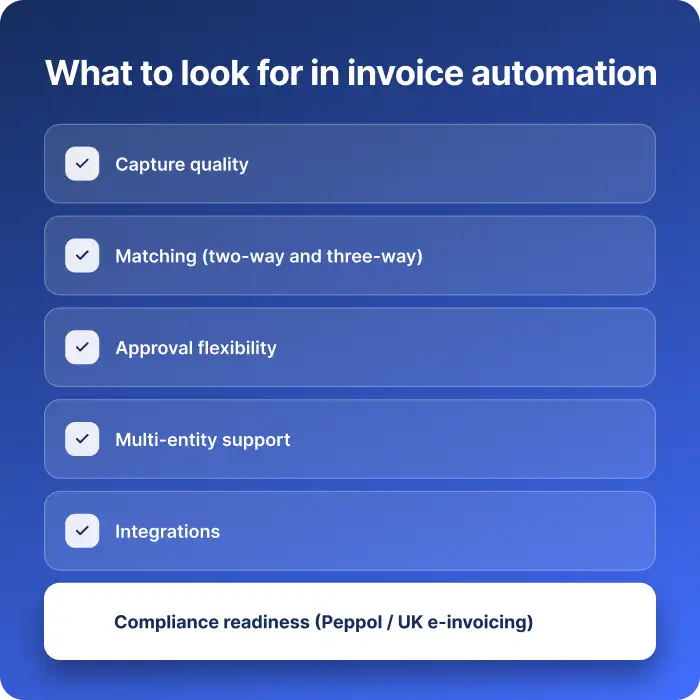
When comparing systems, ask:
- Capture: How much invoice data still needs to be keyed manually?
- Matching: Can PO invoices be matched automatically, and what happens when they don’t match?
- Approvals: Can workflows reflect your actual approval hierarchy and thresholds?
- Exceptions: Can finance see why an invoice has stopped and who needs to act?
- Multi-entity support: Can processes work across a group without constant spreadsheet workarounds?
- Reporting: Does the invoice data feed the dimensions finance uses for management reporting?
- Audit trail: Can you see the invoice, coding, approval history, and accounting record together?
- E-invoicing readiness: How is the provider preparing for upcoming requirements?
A useful demo should show you both a normal invoice and an exception. The second often tells you more.
Automating invoice processing with AccountsIQ
AccountsIQ’s cloud accounting software includes AP capabilities for mid-market and multi-entity finance teams.
Supplier invoices can be captured using OCR-supported workflows, while AccountsIQ also supports purchase-order matching and approval workflows for PO invoices, non-PO invoices, purchase orders, and credit notes.
Approval rules can be based on factors such as:
- invoice value
- supplier
- general ledger code
- approval hierarchy
Where a PO invoice meets configured matching and tolerance rules, it can move through without an unnecessary additional approval step.
That helps keep invoice processing, approval, accounting, and financial reporting closer together, rather than relying on email chains and offline trackers to connect each stage.
💡 Want to see how AccountsIQ works with your own AP process? Book a demo.
Invoice processing FAQs
How do you process an invoice?
An invoice is received, captured, checked, coded, approved, paid, and recorded. Where a purchase order exists, it can also be matched against the original order and goods or services received.
What is three-way matching?
Three-way matching compares the purchase order, the record of goods or services received, and the supplier invoice. If the details agree within the organisation’s rules, the invoice can move forward with greater confidence.
How long does invoice processing take?
It varies by organisation. Ardent Partners’ benchmarking found average processing times of 3.1 days for Best-in-Class teams, compared with 17.4 days for all others.
Is e-invoicing mandatory in the UK?
Not yet. The UK government has confirmed that VAT invoices will need to be issued as e-invoices from 2029, with more implementation detail expected at Budget 2026.
When does mandatory e-invoicing start in Ireland?
Ireland’s first phase starts on 1 November 2028, with further phases following in November 2029 and July 2030.