


Your auditor has mentioned it. Your independent examiner has mentioned it. Maybe a trustee has forwarded you a webinar invite with “SORP 2026” in the subject line.
The question underneath all of that is simple: does this actually change what your charity has to do, and when?
For most charities preparing accruals accounts, the answer is yes.
The Charities SORP, or the Statement of Recommended Practice for Accounting and Reporting by Charities, has been updated for accounting periods beginning on or after 1 January 2026. Broadly, it changes two things:
- How some income and leases appear in your accounts
- How much your trustees’ report needs to say about the difference your charity makes
There’s a simple way to frame it: changes to your numbers, and changes to your story. That can help when you’re explaining SORP 2026 to trustees who don’t need the full technical detail.
The UK's charity sector isn't small. NCVO's UK Civil Society Almanac puts the number of voluntary organisations at around 166,000, with a combined annual income of £69.1 billion. Roughly 80% of those organisations report an income under £100,000.
If that includes your charity, most of what follows still applies, just in its lightest form.
What is the Charities SORP?
The Charities SORP (Statement of Recommended Practice) is the official guidance that sets out how charities should apply UK accounting standards, principally FRS 102, when they prepare their accounts.
FRS 102 is written for all kinds of organisation, so on its own it doesn't address the situations unique to charities: what a restricted fund is, how a legacy should be presented, or what trustees must disclose about volunteers. The Charities SORP fills those gaps.
Think of it as a specialist layer on top of the general accounting rules. FRS 102 sets the foundation; the SORP (you may also see it written as SORP FRS 102 or Charities SORP FRS 102) tells charities how to build on it: what to call things, how to present the Statement of Financial Activities, and what to explain to donors, funders, and the public.
Following the SORP is mandatory in the UK for any charity that prepares accruals accounts. That obligation comes from charity law, and from company law for charitable companies, with the SORP setting out the recognised way to meet it.
Which charities have to follow the SORP?
In the UK, the Charities SORP applies to any charity that prepares accruals accounts. If your charity prepares receipts and payments (cash-based) accounts instead, the SORP does not apply.
So, the deciding factor is the type of accounts you prepare, not what your charity does. Your charitable purpose has no bearing on it.
That splits charities into three positions:
Charitable companies always fall into the first row: company law requires them to prepare accruals accounts regardless of income, so the SORP always applies.
For non-company charities, it comes down to income. Whether you can use receipts and payments accounts depends on a threshold that is due to change, which the next section covers.
The receipts and payments threshold is rising to £500,000
Alongside SORP 2026, a separate change in England and Wales affects which charities have to use accruals accounts at all, and it could take some smaller charities out of the SORP altogether.
Under the current rules, a non-company charity can prepare simpler receipts and payments accounts if its gross income does not exceed £250,000. The government has confirmed this threshold will rise to £500,000, taking effect for accounting periods ending on or after 30 September 2026. Charitable companies are unaffected: they must prepare accruals accounts whatever their income.
For some smaller charities, this matters. A non-company charity that currently prepares accruals accounts only because its income sits above £250,000 may become eligible for receipts and payments accounts once the higher threshold applies. Move to that basis and it also moves outside the scope of the SORP.
Two different dates, and why people mix them up
The two changes are pegged to different points in your accounting period, which is the easiest thing here to get wrong:
- SORP 2026 applies to accounting periods beginning on or after 1 January 2026.
- The £500,000 threshold applies to accounting periods ending on or after 30 September 2026.
A quick way to check which accounts you prepare
Look at your latest accounts:
- If they include a balance sheet with debtors, creditors, and amounts owed, you are preparing accruals accounts, so the SORP applies.
- If they mainly record cash received and cash paid, you are preparing receipts and payments accounts, so the SORP does not.
Before you change how you prepare your accounts, check your legal structure, income, and accounting period with your accountant or independent examiner. The figures above are for England and Wales; Scotland (OSCR) and Northern Ireland (CCNI) set their own thresholds.
What's in a set of SORP accounts?
A SORP-compliant set of charity accounts is built around three core documents: the Statement of Financial Activities, the balance sheet, and the trustees' annual report, all underpinned by fund accounting.
Larger charities also include a cash flow statement, and every set includes notes to the accounts.
1. Statement of Financial Activities (SOFA)
The Statement of Financial Activities, or SOFA, is the charity equivalent of a profit and loss account, but it does more. Instead of driving towards a single profit or loss figure, it shows how the charity used all its resources across the year. It sets out:
- where the charity's income came from,
- how that money was spent,
- how funds moved during the year.
2. Balance sheet
The balance sheet is a snapshot of what the charity owns and owes on the last day of the financial year: its assets, its liabilities, and the funds it holds.
Under SORP 2026, most leases now appear here too, as a right-of-use asset and a matching liability, so charities may show more lease-related assets and liabilities than before, even when nothing about the lease itself has changed.
3. Trustees’ annual report
The trustees' annual report is the narrative that explains the figures. It should cover what the charity set out to achieve, what it did during the year, what it achieved, the challenges it faced, and its plans for the future.
SORP 2026 raises expectations here, particularly around impact, so most charities will need to say more than they have in previous years.
4. Fund accounting
Fund accounting isn't a separate statement; it runs through the whole set of accounts. Charities must keep different types of money separate and clearly reported so readers can see what is available and what strings are attached:
- Restricted funds: Money that must be used for a purpose the donor specified.
- Unrestricted funds: Money trustees can use for the charity's general aims. Designated funds are a subset: Unrestricted money trustees have earmarked for a particular purpose, but could still release if needed.
- Endowment funds: Money held as capital, where the original sum is retained rather than spent.
Keeping funds separate is what lets trustees, donors, funders, and the public see exactly what money the charity has and how freely it can be used.
What's changing under Charities SORP 2026?
The changes split into two groups, the same way the whole update does: changes to your numbers and changes to your story.
Your numbers change through three things:
- A new three-tier reporting structure set by income
- A five-step model for recognising income from contracts
- Most leases moving onto the balance sheet
Your story changes through two: impact reporting becomes mandatory for every charity, and the largest charities must add sustainability disclosures.
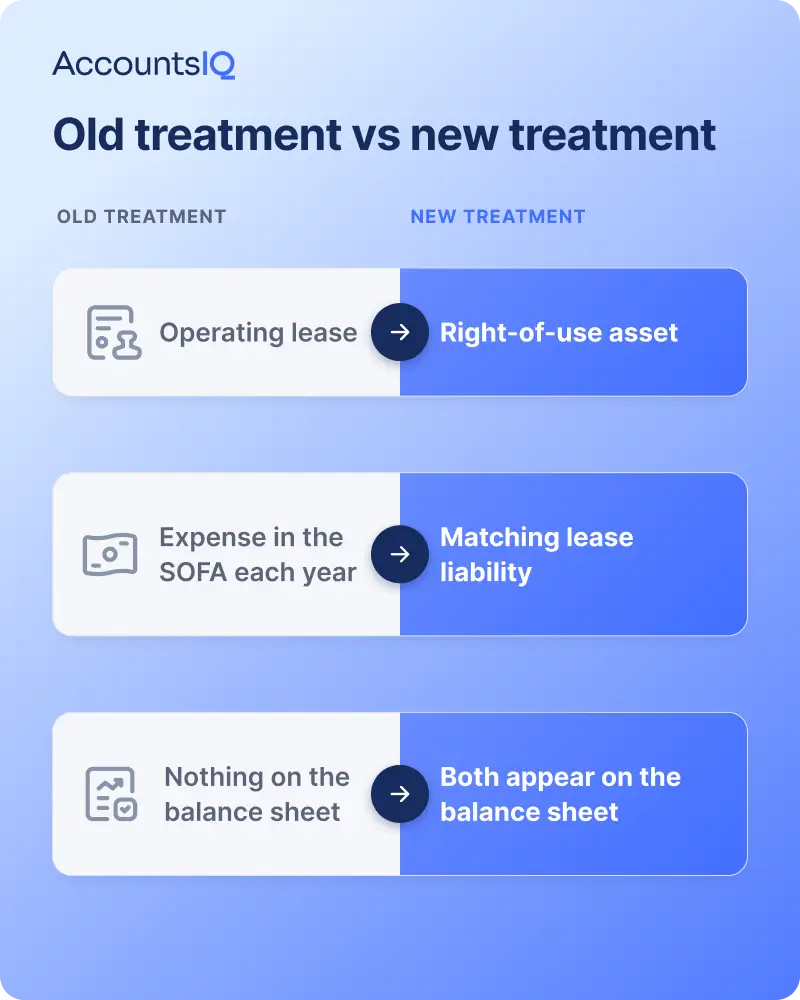
SORP 2019 vs SORP 2026 at a glance
The first of these is a new three-tier reporting structure, set by gross income, which decides how much detail your accounts and trustees’ report must include. The section "Which SORP 2026 tier is your charity in?" below sets out the bands and what each tier should do to prepare.
A new five-step approach to recognising income
SORP 2026 splits income into two types, and how you recognise it depends on which one you're dealing with:
- Exchange transactions: The charity provides goods or services in return, such as training delivered under a service contract.
- Non-exchange transactions: The charity receives income without providing equivalent value, such as a donation or unrestricted legacy.
Exchange transactions follow five steps:
- Identify the contract.
- Identify what the charity has promised to deliver.
- Calculate the transaction price.
- Allocate the price across the deliverables.
- Recognise income as each deliverable is completed.
For example, a £60,000 grant linked to a two-year employment programme and quarterly performance reports may operate more like a service contract than a gift. The charity may need to recognise income as it delivers the programme, rather than when the cash arrives.
An unrestricted £60,000 legacy is different. No service is provided in return, so it is generally recognised once receipt is sufficiently certain and the value is known.
Review grants and contracts before year end. Pay particular attention to agreements with milestones, outcome conditions or several deliverables.
Most leases will appear on the balance sheet
Under SORP 2026, most leases will create:
- A corresponding lease liability
Assets and liabilities may therefore increase even where the lease itself has not changed. Short-term and low-value leases may be exempt.
Peppercorn and below-market leases need extra attention. The benefit of paying less than market rent may need to be recognised alongside the lease itself.
A trustees’ report focused on impact
SORP 2026 asks trustees to explain not only what the charity did, but what difference it made.
A useful report should distinguish between:
- Activity: What was delivered
- Output: The immediate result
- Impact: The change created for beneficiaries
How much you write scales with your tier. Tier 1 charities may need only a concise explanation backed by a few examples; Tier 2 and Tier 3 charities are expected to say more about outcomes and longer-term effects.
The report should also describe the contribution volunteers make, and Tier 3 charities carry the additional sustainability requirements, which smaller charities can choose to report on voluntarily.
Keep it proportionate. Beneficiary feedback, programme data, case studies, and the funder reports you already produce will usually supply most of the evidence you need.
When does SORP 2026 apply to your charity?
SORP 2026 applies to accounting periods that begin on or after 1 January 2026.
The key date is the start of your accounting period, not the date on which the financial year ends.
Can you adopt SORP 2026 early?
Early adoption is permitted.
However, the charity must apply SORP 2026 in full. It cannot use selected parts of SORP 2026 while continuing to apply other parts of SORP 2019 in the same set of accounts.
Do you need to restate the previous year?
Prior-year figures do not need to be restated under the new lease and income-recognition rules.
Instead:
- Comparative figures remain on the previous accounting basis.
- The new treatment takes effect from the start of the first accounting period under SORP 2026.
- Finance teams need reliable records at the transition date.
- A complete two-year rebuild should not be required.
The practical priority is to identify your transition date and make sure the supporting income, contract and lease records are complete from that point onwards.
Which SORP 2026 tier is your charity in?
Your tier is set by your gross income for the reporting period, and it determines how much detail your accounts and trustees' annual report must include. There are three: Tier 1 under £500,000, Tier 2 from £500,000 to £15 million, and Tier 3 above £15 million.
Find your income band below for what it means in practice and where to focus first.
Your tier depends on gross income alone, not on what the charity does. A £2 million medical research charity and a £2 million environmental charity face identical Tier 2 requirements, whatever their cause.
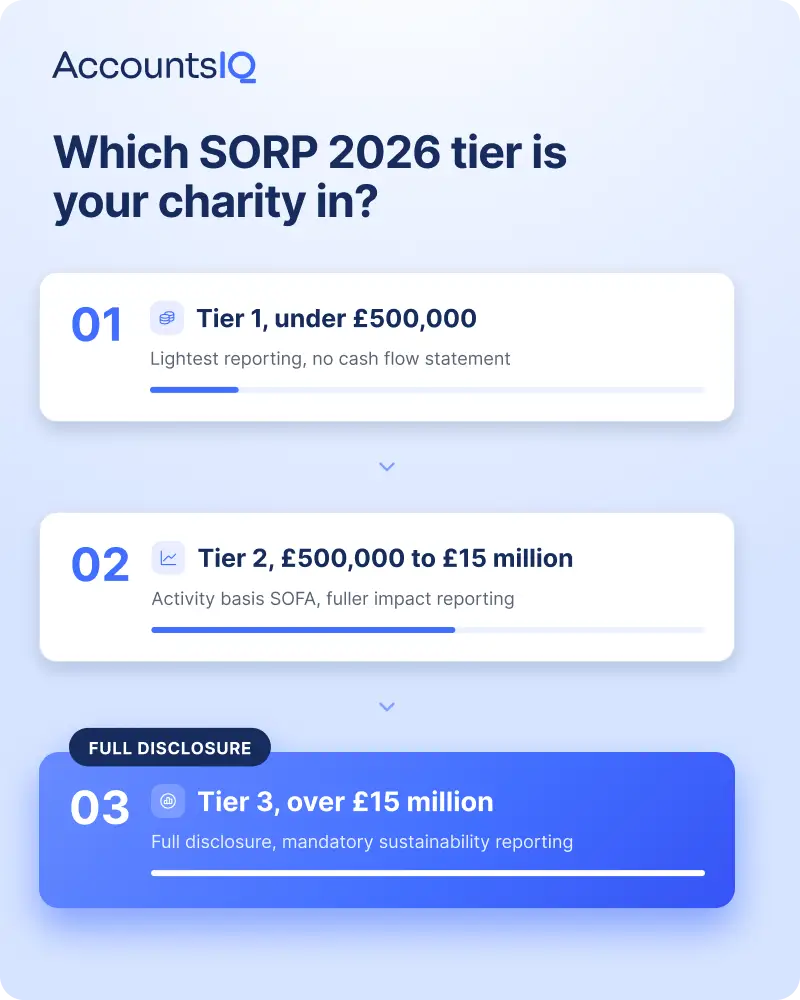
If your income is near a boundary
Watch your gross income closely if it's approaching £500,000 or £15 million, because crossing either line can change your requirements for that whole year. Income that rises one year and falls the next is the awkward case: your tier can move with it, since it's set year by year with no averaging.
If you're hovering around a boundary, raise it with your independent examiner, accountant, or auditor before year end, not while the accounts are being drafted. That gives you time to gather the extra information a higher tier needs rather than discovering the gap too late.
How to get ready for SORP 2026
Getting ready for SORP 2026 is mostly a data exercise. Nearly all of it comes down to collecting information you can already gather now, so the earlier you start, the less your finance team has to reconstruct at year end.
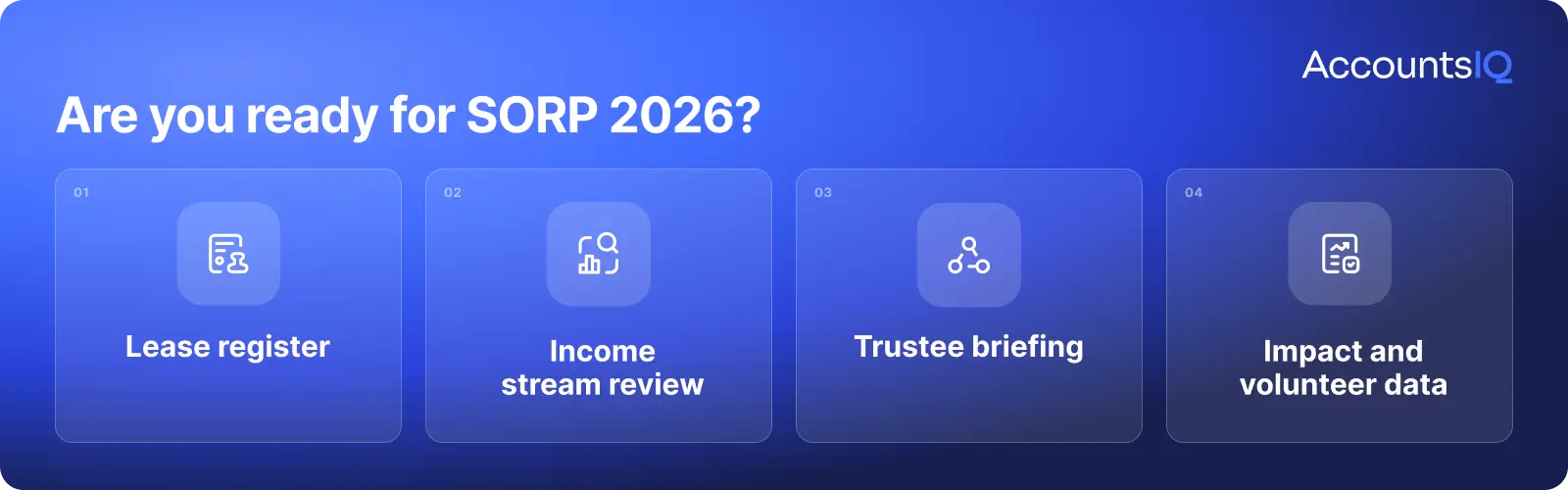
Focus on four areas: your leases, your income agreements, your trustees and programme teams, and your impact and volunteer data.
1. Build a complete lease register
List every property, vehicle, and equipment lease the charity holds, because most of them now have to be recognised on the balance sheet. For each one, record:
- start and end dates,
- rent and payment frequency,
- renewal and break options,
- rent-free periods,
- any peppercorn or below-market arrangement,
- the discount rate used,
- any exemption applied, and
- which entity, fund, or project uses the asset.
This is likely to be the most time-consuming part of the transition, especially where lease details are scattered across contracts, spreadsheets, and different teams. Getting it into one register now is what makes the year-end calculation manageable later.
2. Review grants, contracts, and other income
Separate your straightforward donations and legacies from funding that requires the charity to deliver specific goods, services, or outcomes. The second group is where the new income rules bite.
Pay closest attention to agreements with:
- performance conditions,
- milestone payments,
- several distinct deliverables,
- reporting tied to payment, or
- funding released in stages.
Where an arrangement looks like an exchange transaction, work it through the five-step income-recognition model before year end. That tells you what to recognise, how to allocate it, and which period it belongs in, well before the accounts are being drafted.
3. Brief trustees and programme teams early
Don't wait until the trustees' report is being written to start talking about impact. By then the year is over and the evidence is whatever happens to have been kept.
Make sure trustees and programme teams understand:
- what evidence the report will need,
- how activity differs from output and impact,
- which examples best show the difference the charity made,
- where results fell short of the plan, and
- what future plans need explaining.
Much of this already exists in programme reports, beneficiary feedback, and funder updates. The job is to gather it consistently and get it to whoever writes the report.
4. Capture impact and volunteer data throughout the year
Impact reporting is far harder when the evidence has to be reconstructed after year end. Put simple, routine processes in place to record:
- programme outcomes,
- beneficiary feedback,
- relevant case studies,
- volunteer numbers and hours,
- the roles volunteers perform, and
- progress against the charity's objectives.
None of this needs to be elaborate. It needs to be consistent, easy to find, and tied to the activities you'll be reporting on.
Let your finance system do the heavy lifting
All four steps get easier when income and expenditure are coded correctly as they're entered, rather than sorted out afterwards. A finance system that can tag every transaction by fund, grant, project, activity, or department gives you a clean reporting trail and cuts the year-end scramble to rebuild figures in spreadsheets.
If you're reviewing your wider finance setup, our guide to the best accounting software for charities in the UK covers what to look for beyond SORP compliance alone.
AccountsIQ lets charities code income and expenditure by several dimensions at once, including fund, grant, project, and department, as each transaction is entered. The analysis SORP reporting needs is then drawn straight from the underlying finance data instead of being pieced together by hand at year end.
You can also see how other charities are using AccountsIQ to modernise their finance processes and improve their reporting.
💡 Book a demo of AccountsIQ to see how fund, grant, and project reporting could work for your charity.
Charity SORP FAQs
What does SORP stand for, and what does it actually mean?
SORP stands for Statement of Recommended Practice. For charities, it's the guidance that explains how to apply UK accounting standards, mainly FRS 102, to charity-specific situations such as restricted funds, legacies and grants.
Is following the Charity SORP a legal requirement?
In the UK, yes, for any charity that prepares accruals accounts. The requirement comes from charity law and, for charitable companies, company law, with the SORP setting out the recognised way of meeting it. Charities preparing receipts and payments accounts aren't required to follow it.
Does the Charity SORP apply to charities in Ireland?
Not in the same way. The SORP itself describes its recommendations as good practice for charities in the Republic of Ireland, rather than a legal requirement. That's expected to shift once the Charities (Amendment) Act 2024 is fully commenced.
We prepare receipts and payments accounts. Does SORP 2026 affect us?
Not directly. The SORP only applies to accruals accounts. If you currently prepare accruals accounts because your income sits above the £250,000 threshold, check whether the rise to £500,000, expected from September 2026, changes your position, since that could move you into receipts and payments territory and out of SORP scope.
Our year-end is 31 March. When does SORP 2026 first apply to us?
Your first affected accounting period starts on 1 April 2026, so SORP 2026 applies for the first time to your year ending 31 March 2027. Your year ending 31 Marc