


Intercompany accounting has an outsized impact on the close. In an EY survey, 53% of companies identified intercompany reconciliation as the area with the greatest potential to speed up their closing process.
The problem usually isn’t one complicated transaction. It’s the volume of ordinary ones that have to agree across different entities: intragroup sales, management charges, loans, cost allocations, and more.
One entity posts late. Another uses a different account. Exchange rates move. A balance is missing its matching entry. Individually, the differences can look small. At group level, finance still has to find and resolve them before the numbers can be consolidated cleanly.
Add more entities, currencies, and transactions, and that job gets harder fast.
What is intercompany accounting?
Intercompany accounting is the process of recording, reconciling, and eliminating transactions between entities within the same corporate group.
Each entity records its side of the transaction in its own ledger. Before consolidation, the corresponding balances are reconciled to make sure they agree. The group then eliminates the intragroup transactions and balances so the consolidated accounts reflect the group’s position and performance with external parties.
What counts as an intercompany transaction?
Most intercompany activity falls into a handful of recurring types.
How intercompany accounting works: record, reconcile, eliminate
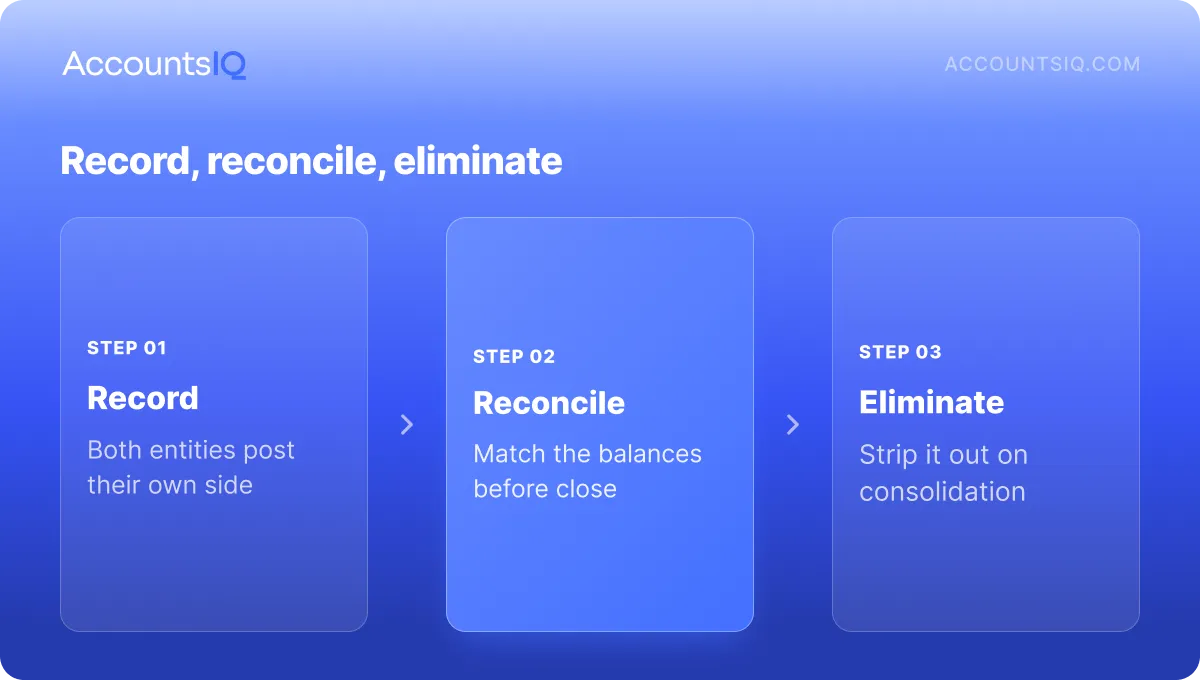
Intercompany accounting follows three core stages: record the transaction in each entity, reconcile the two sides, then eliminate the intragroup activity on consolidation.
Step 1: Record it on both sides
Each entity records its side of the transaction in its own ledger.
If entity A invoices entity B for £50,000, entity A records £50,000 of revenue and an intercompany receivable. Entity B records the corresponding cost or asset and an intercompany payable.
Using consistent intercompany accounts and coding across the group makes those entries much easier to identify and match later.
Step 2: Reconcile the balances
Before consolidation, the corresponding balances need to agree.
Entity A’s receivable from entity B should reconcile to entity B’s payable to entity A. Where they don’t, finance needs to identify the reason. For example, a timing difference, inconsistent coding, a missing entry or a foreign-currency difference.
Reconciling regularly rather than leaving everything until period-end helps stop small differences becoming a long exceptions list at close.
Step 3: Eliminate on consolidation
Once the balances agree, the group eliminates the intragroup transactions and balances on consolidation.
That includes items such as intercompany revenue and costs, receivables and payables, and unrealised profit included in assets such as inventory.
The result is a consolidated view that reflects the group’s activity and position with external parties rather than transactions between its own entities.
A worked example: parent sells inventory to a subsidiary
Say a parent company holds stock that originally cost £40,000. It sells that stock to its subsidiary for £50,000, creating a £10,000 profit in the parent’s individual accounts.
At year-end, the subsidiary still holds all the stock and has not sold it to an external customer.
At entity level:
- The parent records £50,000 of sales, £40,000 of cost of sales, and £10,000 of profit. It also records a £50,000 intercompany receivable.
- The subsidiary records inventory of £50,000 and a £50,000 intercompany payable.
Those entries are correct for the individual entities. But from the group’s perspective, the stock has simply moved from one group company to another. No sale to an external customer has taken place.
On consolidation, the group therefore:
- eliminates the £50,000 intercompany receivable and payable
- removes the £50,000 intragroup sale from group revenue
- reverses the £40,000 cost of sales recognised by the parent, because the stock is still held within the group
- removes the £10,000 unrealised profit from inventory, bringing its consolidated carrying amount back to the group’s original £40,000 cost
After those adjustments, the consolidated accounts show no external revenue or profit from the transfer, and inventory remains at the £40,000 cost incurred by the group.
That last £10,000 adjustment matters. Without it, the group would report profit before anything had been sold externally and carry the inventory at £10,000 more than its cost to the group.
Intercompany reconciliation: why it stalls the close, and how to fix it
Intercompany reconciliation becomes a bottleneck when the balance recorded by one entity doesn’t match the corresponding balance elsewhere in the group.
Why intercompany balances don’t match
Common causes include:
- Timing differences: one entity records the transaction in a different period.
- FX differences: different currencies, exchange rates or transaction dates produce different reported amounts.
- Inconsistent coding: the two sides are posted to different intercompany accounts or entity codes.
- Missing or incorrect entries: one side is absent, duplicated or recorded for the wrong amount.
- Fragmented processes: spreadsheets, emails and separate systems make outstanding differences harder to track.
How to reduce intercompany reconciliation problems
Set clear cut-off dates and ownership, use consistent intercompany identifiers and account mappings, and reconcile throughout the period rather than waiting until month-end.
Where FX creates a difference, identify it separately and account for it according to the group’s policy and applicable reporting standard rather than treating it as an ordinary mismatch.
Keeping the two sides aligned during the month means fewer exceptions to investigate when consolidation begins.
Intercompany eliminations and the standards you report against
If a group prepares consolidated financial statements, intragroup transactions and balances need to be eliminated so the accounts reflect the group as a single reporting entity.
The exact requirements depend on the reporting framework and jurisdiction.
IFRS 10: eliminate intragroup activity in full
IFRS 10, Consolidated Financial Statements sets out how groups reporting under IFRS prepare consolidated financial statements.
Under paragraph B86:
- intragroup assets and liabilities are eliminated
- intragroup income and expenses are eliminated
- intragroup cash flows are eliminated
- profits or losses included in assets such as inventory are eliminated
That is why the £10,000 unrealised profit in the inventory example above cannot remain in the consolidated accounts while the stock is still held within the group.
FRS 102 Section 9: the UK and Republic of Ireland GAAP position
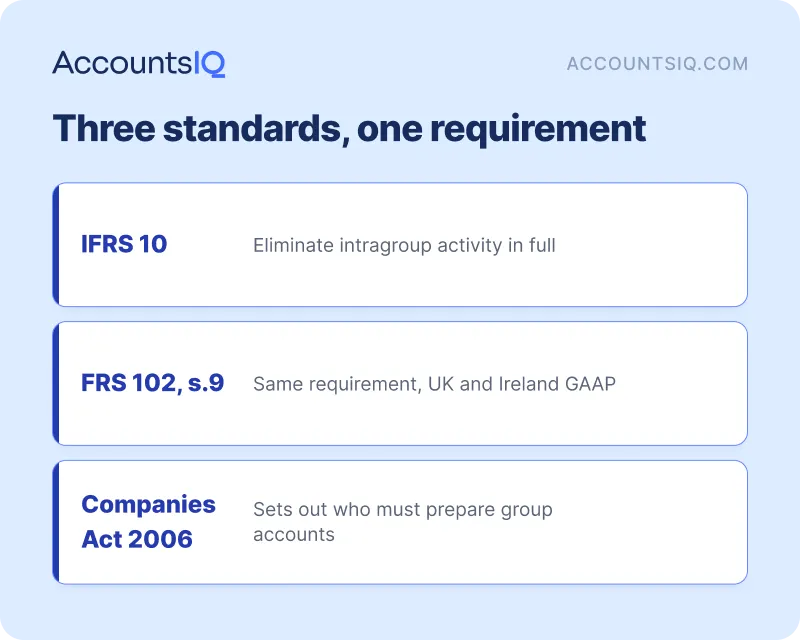
Groups reporting under FRS 102 follow the consolidation requirements in Section 9.
Paragraph 9.15 requires the full elimination of:
- intragroup balances
- intragroup transactions
- intragroup income and expenses
- intragroup dividends
- profits and losses from intragroup transactions that remain recognised in assets, such as inventory or property, plant and equipment
So, while IFRS 10 and FRS 102 are different reporting frameworks, the core intercompany principle is the same: transactions and balances within the group are removed from the consolidated accounts.
Small-group consolidation exemptions in the UK and Ireland
The accounting framework determines how a group consolidates. Company law helps determine whether a parent is required to prepare group accounts in the first place.
Qualifying small-group parents may be exempt from preparing consolidated group accounts, but size is not the only eligibility condition.
Confirm your group’s position against current official guidance and with your accounting or legal advisers.
What happens when intercompany accounting goes wrong?
Unresolved intercompany differences can affect more than one entity’s ledger. By the time the group consolidates, they can create problems across the close.
- Misstated group results: missed eliminations can overstate revenue, profit, assets or liabilities.
- A slower close: unmatched balances leave finance investigating differences when consolidation should already be underway.
- More audit work: unexplained balances and weak supporting records can lead to additional questions and evidence requests.
- Prior-period corrections: a material error identified later may require retrospective correction under the applicable accounting standard.
- More pressure on reporting deadlines: every extra day spent resolving intercompany differences leaves less time for review, sign-off and filing.
The more entities and intercompany transactions a group has, the harder those problems become to contain manually.
Why intercompany accounting gets harder as you add entities
Adding entities doesn’t change the basic process: record, reconcile, eliminate. What changes is the number of relationships finance has to keep aligned.
If every entity in a group can transact with every other entity, the number of possible intercompany relationships rises quickly:
Not every entity will trade with every other one, of course. But the principle is the same: as the group grows, finance has more balances, counterparties and exceptions to coordinate at each close.
That creates four common scaling problems:
- More transactions to match: every additional intercompany sale, loan, charge or allocation creates another corresponding entry that needs to agree somewhere else in the group.
- More systems and coding differences: different entities may use different accounting systems, charts of accounts, currencies or posting conventions, making consistent matching harder.
- More exceptions to investigate: timing differences, missing entries and incorrect coding become harder to spot when they are spread across a larger group.
- More manual coordination: spreadsheets and email can provide a workable process at small scale, but the effort required to collect balances, identify mismatches and chase corrections grows as more entities are added.
The challenge, then, isn’t that intercompany accounting becomes fundamentally different. It’s that a process built around manual coordination has to handle more relationships every time the group expands.
Intercompany accounting best practices that hold up at close
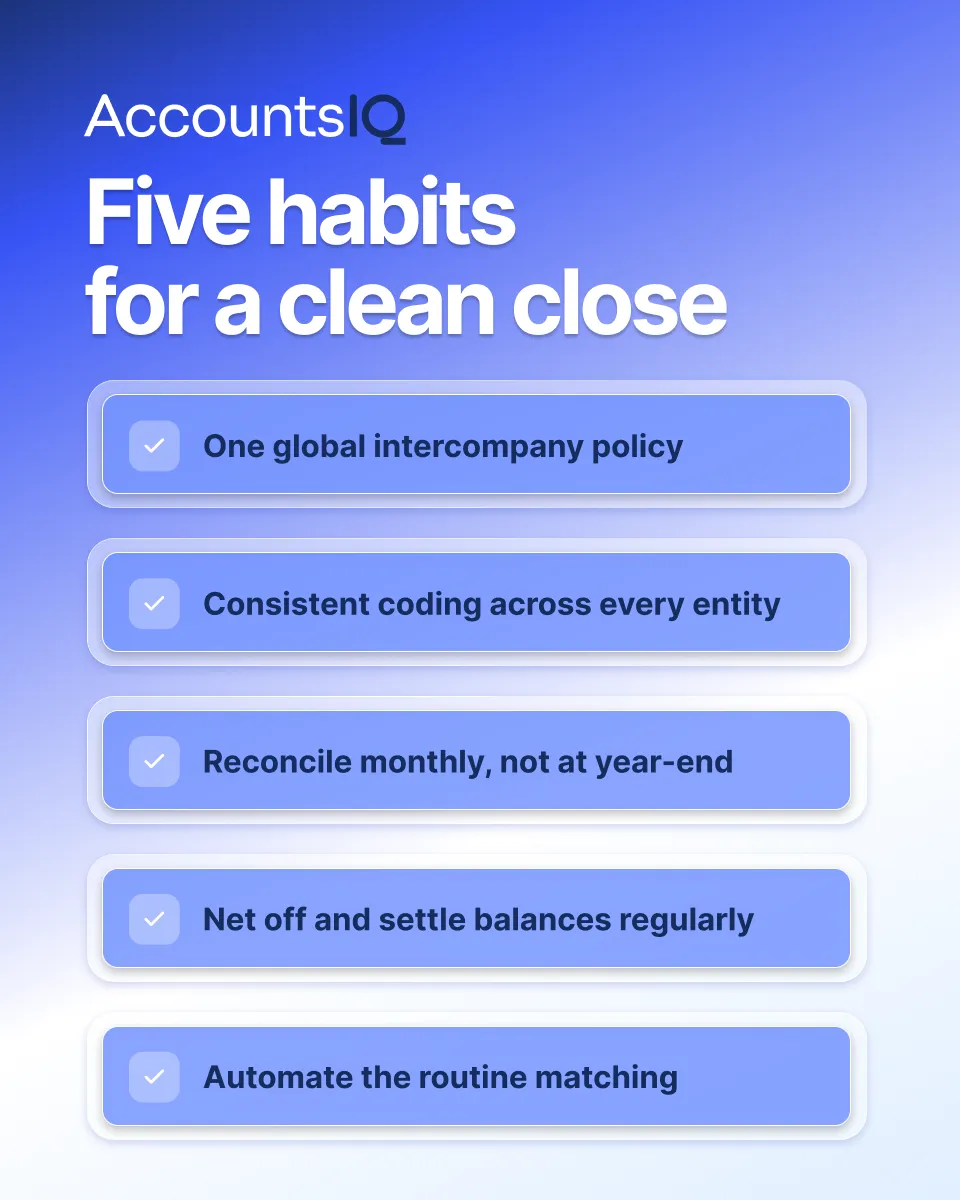
The best way to reduce intercompany problems at close is to stop differences building up during the period.
- Use one group-wide policy: standardise how intercompany transactions are raised, coded, approved, and cut off.
- Standardise accounts and identifiers: make it easy to identify the counterparty and corresponding entry across every entity.
- Reconcile regularly: find timing differences, missing entries and coding errors before consolidation starts.
- Set clear ownership: make each entity responsible for resolving its outstanding differences by an agreed cut-off.
- Review settlement regularly: clear or net balances where appropriate under the group’s accounting, tax and treasury policies.
- Automate repeatable matching: use automation for routine items so finance can focus on genuine exceptions.
Consistency across entities is what makes the process scalable. The fewer differences created upstream, the fewer finance has to investigate at close.
What to look for in intercompany accounting software
Software won’t fix an inconsistent intercompany policy. But once the process is defined, the right system can reduce the manual work involved in keeping transactions aligned across entities.
Look for capabilities that address the points where intercompany accounting typically becomes difficult:
Where AccountsIQ fits
AccountsIQ brings intercompany management and group consolidation into the same accounting environment.
Finance teams can use it to:
- generate corresponding intercompany transactions across linked entities
- monitor real-time intercompany balances and out-of-balance accounts
- reconcile through an IC Matrix report with transaction-level drill-down
- automate configured intercompany funds transfers and reconciliation
- consolidate entities across multiple currencies
- automatically eliminate configured intercompany balances during consolidation
That means fewer separate spreadsheets between the transaction, reconciliation, and consolidation stages.
💡 Book a demo to see how AccountsIQ handles intercompany transactions, reconciliation, and consolidation across a multi-entity group.
Intercompany accounting FAQs
Is there a difference between an intercompany and an intragroup transaction?
Usually, no. Both describe transactions between entities in the same group. IFRS 10 tends to use "intragroup", while "intercompany" is more common in everyday finance language.
What is the difference between intercompany reconciliation and elimination?
Reconciliation checks that both entities have recorded the transaction consistently. Elimination removes the intragroup transaction and balance from the consolidated accounts.
In short: reconcile to make the two sides agree; eliminate to remove internal group activity.
What are downstream, upstream and lateral intercompany transactions?
- Downstream: parent to subsidiary
- Upstream: subsidiary to parent
- Lateral: between two subsidiaries in the same group
Do smaller UK and Irish groups still need to account for intercompany transactions?
Yes. Individual entities still need to record intercompany transactions correctly.
What may differ is whether the parent must prepare consolidated group accounts. Small-group exemptions can apply under the Companies Act 2006 in the UK and the Companies Act 2014 in the Republic of Ireland.
Which accounting standards cover intercompany eliminations in the UK and Ireland?
Groups reporting under IFRS follow IFRS 10. Groups using FRS 102 follow Section 9 of FRS 102.
Both require intragroup transactions and balances to be eliminated on consolidation.