

.webp)
Every property in the portfolio has its own ledger. Every entity has its own set of books. And every month-end, someone rebuilds the group picture in a spreadsheet that only they fully understand.
Real estate management accounting software is the finance system that sits underneath a property portfolio: one general ledger, one consolidation process, and one place to report by property, entity, or the whole group.
This guide is for finance leaders, controllers, and CFOs at multi-entity property groups, commercial real estate businesses, and REITs who are deciding whether their current system can still do that job. If you're a landlord managing a handful of buy-to-let properties, the tools further down this guide will be more than you need.
What is real estate management accounting software?
Real estate management accounting software is a finance system built to handle a property portfolio's specific structure: multiple properties, multiple legal entities, and often multiple currencies, all reporting up into one set of group accounts.
At a portfolio level, the system needs to do four jobs well. It has to:
- Hold a consolidated general ledger across every entity in the group
- Track results at property and entity level without losing the group view
- Support a close that doesn't take weeks
- Produce real-time reporting that a finance director can actually rely on between month-ends
Get those four right, and the rest of the finance function gets easier. Miss one, and the workaround usually ends up in a spreadsheet.
How real estate accounting software differs from the tools you already use
Most comparison articles on this topic blur three different categories together:
- Entry-level accounting software
- Property management platforms
- Finance systems built for portfolios
They solve different problems, and knowing which one you actually need saves months of wasted evaluation.
Real estate accounting software vs Xero, QuickBooks, and Sage 50: where entry-level tools stall
Xero, QuickBooks, and Sage 50 are powerful for what they're built for. A single entity, a manageable transaction volume, and straightforward reporting needs. Plenty of smaller property businesses run happily on one of these for years.
The strain shows up as the portfolio grows.
Add a second or third entity and consolidation stops being a report you run and starts being a spreadsheet you build by hand every month. Add a second currency and that spreadsheet gets a lot more fragile. Add intercompany loans or management recharges between properties and eliminations become a manual reconciliation exercise that eats days rather than hours.
None of this means the entry-level tool was the wrong choice originally. It usually means the business has changed shape faster than the system was designed to follow.
Accounting software vs property management software: who owns what, and where each one stops
Your accounting software owns the general ledger, consolidation, intercompany eliminations, and statutory reporting. Your property management software owns rent collection, tenancy records, lease terms, and maintenance requests.
One produces your accounts. The other runs your buildings.
Trying to make a property management platform do group consolidation, or trying to make a general ledger track tenancy agreements, tends to produce the same result: a system stretched past what it was built for, patched together with exports and spreadsheets.
Do you need both a finance system and a property management system?
For most multi-entity property businesses, yes.
The two systems answer different questions for different people, and trying to collapse them into one usually means one side of the business is underserved.
Where this works well, the property management system feeds transactional data (rent charges, service charge income, maintenance costs) into the finance system through an integration, and the finance system handles consolidation, reporting, and the numbers that go to the board, lenders, or investors.
For example, AccountsIQ is a cloud accounting software that connects to property management platforms through an open API, so data moves between the two without manual re-entry.
The features that matter for a multi-entity property portfolio
Once you've separated the two categories, the buying decision comes down to a shorter list of features that actually matter for a portfolio of this size.
Multi-entity and multi-currency consolidation
The core job. A property group with entities in different structures, and sometimes different currencies, needs consolidation that runs automatically rather than one that gets rebuilt in Excel every period.
Look for a system that consolidates across as many entities as your portfolio needs, not a number that quietly caps out.
Reporting by property, entity, or whole portfolio
Finance teams need to answer the same underlying question in several different shapes: how is this property performing, how is this entity performing, and how is the group performing?
Dimensional reporting, where transactions carry property, entity, and cost centre tags from the point of entry, means those views come from the same data rather than three separate exports.
A faster, cleaner month-end close
Slow closes are rarely about effort. They're about how many manual steps sit between the trial balance and a finished set of consolidated accounts.
This is highlighted in APQC's widely cited benchmarking study of over 2,300 organisations puts the median cycle time to close at around six days, with top-quartile performers closing in under five.
That's a cross-industry figure, not a property-specific one, but the direction of travel matters: for multi-entity groups specifically, consolidation and intercompany work are consistently the biggest contributors to a close running long.
Intercompany transactions and eliminations
Property groups generate more intercompany activity than most business types. Management fees between a holding company and its subsidiaries, loans between entities, recharges for shared services.
A 2025 industry survey by finance automation platform Ledge found that a large majority of finance teams are still handling parts of their close in spreadsheets, with intercompany work among the most manual and time-consuming areas.
A system that automates eliminations, rather than leaving them to a spreadsheet reconciled by one person, removes a genuine bottleneck.
Real-time visibility and portfolio KPIs
Waiting until month-end to see whether a property is profitable is a habit finance teams inherit from their systems, not a habit they choose.
Real-time dashboards mean a finance director can check portfolio cash flow or property-level performance on any given day, not just after the close.
Open API and integrations with your property stack
Your finance system doesn't operate in isolation. It needs to connect cleanly with your property management platform, your banking, and your expense management system.
An open API means these connections can be built and maintained without a developer rebuilding an integration every time something changes upstream.
Signs you've outgrown spreadsheets and entry-level accounting
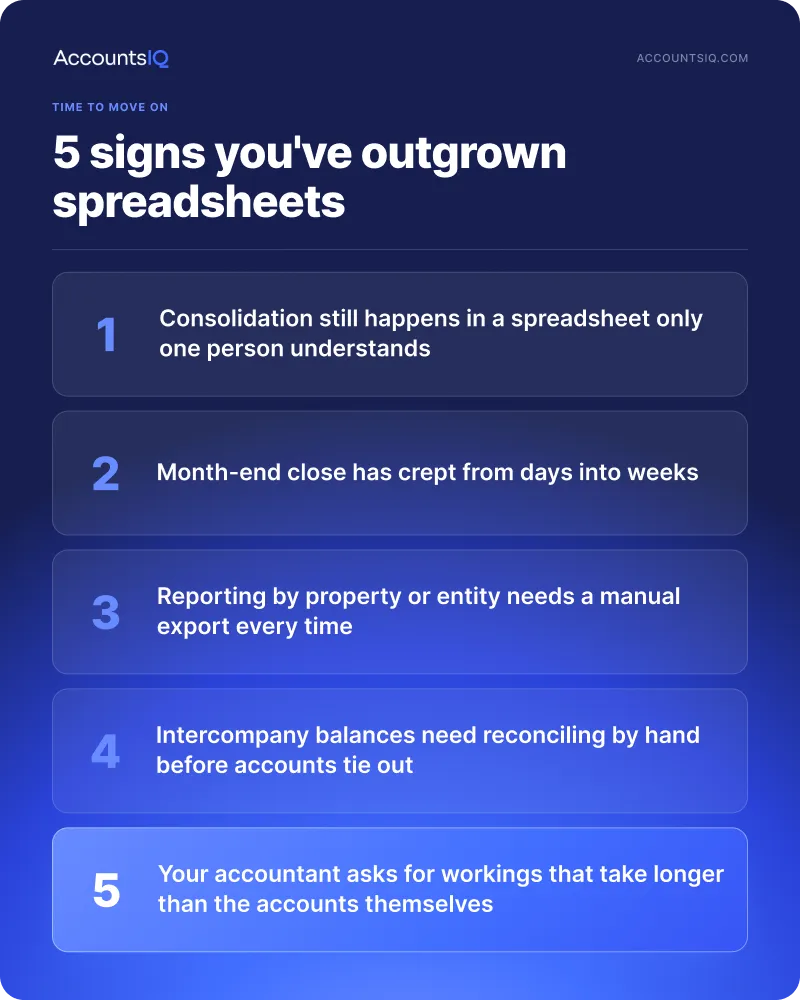
The signs are rarely dramatic. They show up as small, repeated frictions that finance teams learn to live with:
- Consolidation still happens in a spreadsheet that one person understands.
- Month-end close has crept from days into weeks.
- Reporting by property or entity needs a manual export and a pivot table every time someone asks.
- Intercompany balances need reconciling by hand before the group accounts will tie out.
- Your accountant asks for supporting workings that take longer to prepare than the accounts themselves.
Joanne Brown, Financial Controller at E&J Estates, put the change in concrete terms:
"In previous years, we produced accounts for our auditors around four months after year-end. This year, with AccountsIQ, we did it in just six weeks and next year our target is to get it done in a month."
That's the practical difference a proper finance system makes. A close that finishes in weeks rather than months.
Property accounting for REITs, service charges, and commercial portfolios
REITs and commercial portfolios carry reporting requirements that go beyond a standard multi-entity close.
There are around 170 UK REITs currently operating, spanning listed and non-listed structures, and each one must distribute at least 90% of its net property rental income to investors within 12 months of the accounting period ending, a requirement that puts real pressure on how quickly and accurately the numbers come together.
Commercial portfolios bring their own layer of complexity on top of standard consolidation: service charge accounting, CAM-style reconciliations across tenants, and investor or lender reporting that needs to be produced on a predictable schedule rather than whenever the spreadsheet allows.
For these businesses, the finance system needs to support that reporting rhythm directly, rather than treating it as a special exercise the team runs once a year under pressure.
How to choose real estate management accounting software: a finance leader's checklist
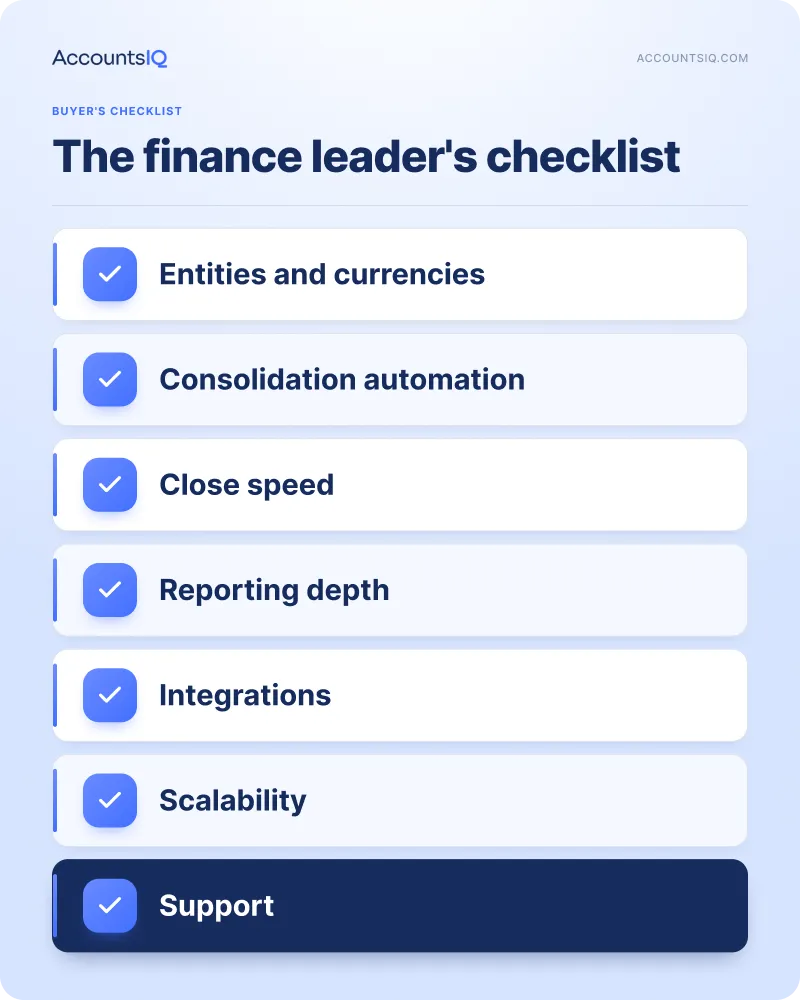
Use this as a working checklist when you're evaluating systems:
- Entities and currencies: Does the system consolidate every entity in your current structure, and the ones you're likely to add?
- Consolidation: Does consolidation run automatically, or does someone need to rebuild it in a spreadsheet each period?
- Close speed: What does the vendor's own customer base report for close time, and can they show you a real example?
- Reporting depth: Can you report by property, entity, department, or portfolio from the same underlying data?
- Integrations: Does it have an open API that connects to your property management platform, banking, and expense tools?
- Scalability: Will it still work cleanly when you add your next five entities, not just your next one?
- Support: Is implementation and ongoing support built for a finance team, or bolted on as an afterthought?
If you can't answer most of these confidently about your current system, that's usually the clearest sign it's time to look properly.
Where AccountsIQ fits
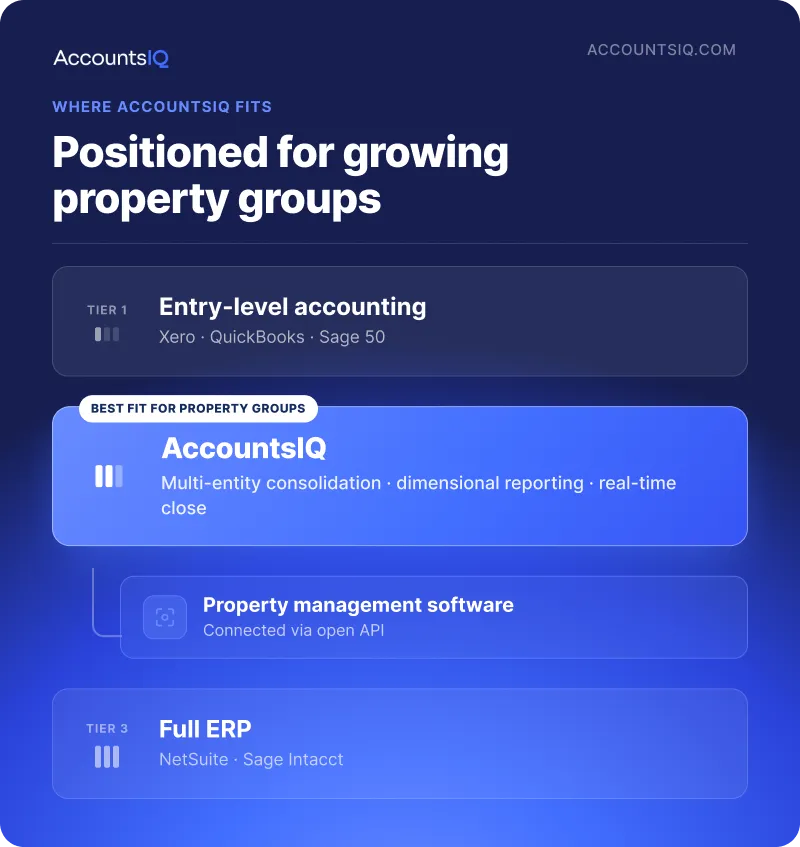
AccountsIQ sits between entry-level accounting software and full ERP, built specifically for the finance work a growing, multi-entity property business needs: consolidation, dimensional reporting, and a close that doesn't rely on one person's spreadsheet.
It isn't a property management system, and it isn't trying to be. It's the finance layer that sits alongside your property management platform, connected through an open API, so your operational team keeps working the way they already do while finance gets a group view they can trust.
E&J Estates' experience is a fair example of what that looks like in practice: a close that used to take four months compressed into six weeks, with a further target of one month.
That's the kind of change a finance-first system makes possible, by removing the manual steps that were slowing the close down in the first place.
💡 Book a demo to see how AccountsIQ can support your portfolio's consolidation, reporting, and close.
Frequently asked questions: real estate management accounting software
What is the difference between real estate accounting software and property management software?
- Real estate accounting software manages the general ledger, multi-entity consolidation, and statutory reporting for a property group.
- Property management software manages the operational side: rent collection, tenancies, and maintenance. Most multi-entity property businesses need both, connected through an integration.
Can I use Xero, QuickBooks, or Sage 50 for a property portfolio?
Plenty of property businesses start on Xero, QuickBooks, or Sage 50, and for a single entity with straightforward reporting, that's often the right call. The ceiling shows up as the portfolio grows:
- A second or third entity turns consolidation into a manual spreadsheet job
- A second currency makes that spreadsheet more fragile
- Intercompany activity between properties adds a reconciliation step none of these tools were built to automate
At that point, most finance teams look for an accounting system built specifically for multi-entity groups, like AccountsIQ.
Do I need both an accounting system and a property management system?
Most multi-entity property businesses do.
The property management system handles tenancies and maintenance, and the finance system handles consolidation, reporting, and group accounts. An open API lets the two share data without manual re-entry.
How does real estate accounting software speed up month-end close?
By automating consolidation and intercompany eliminations that would otherwise be rebuilt manually in spreadsheets each period, and by giving finance teams dimensional reporting so they don't need separate exports for property, entity, and group-level views.
Is this the same as landlord accounting software?
No. Landlord accounting software is built for individuals or small portfolios managing a handful of properties. Real estate management accounting software is built for multi-entity property groups, commercial real estate businesses, and REITs with more complex consolidation and reporting needs.