


The best accounting software in the UK is the platform that matches your finance team's complexity, not the one with the longest feature list.
- A sole trader needs something simple and Making Tax Digital ready.
- A multi-entity group needs consolidation and group reporting.
- A large, operationally complex business may need a full ERP.
Get the tier right first, then compare products within it.
Most finance systems don't fail overnight. They get worked around. Consolidation moves into spreadsheets. The board pack depends on the one person who knows which exports to run. Month-end takes a day longer every quarter, until nobody quite remembers when it used to take three days instead of five.
And that reliance on manual work is still widespread.
A 2026 Sixthfin and Odoxa study found that 67% of UK companies with more than 250 employees still use Excel for account analysis and reconciliation, including 62% of mid-sized businesses. Useful, yes. But often a sign that the finance system, the reporting demands, and the complexity of the business have stopped lining up.
How to judge your finance complexity before you choose
Before comparing products, work out which tier you actually sit in. Five things drive that, more than turnover or headcount alone:
- Number of legal entities: one company is a different problem to five, even at the same revenue.
- Currencies: a single-currency business has very different reporting needs to one invoicing in dollars and euros.
- How long month-end actually takes, and how much of that time goes on manual checking rather than analysis.
- The depth of reporting the board or investors expect, and whether you can produce it without rebuilding it in a spreadsheet.
- Transaction volume, and whether it is growing faster than your current system and processes can absorb.
If you can't answer these quickly, that's useful information in itself. It usually means reporting has already outgrown the system, even if nobody has said so out loud.
The four tiers of UK accounting software, compared
Cloud accounting software covers a huge range, from single-user invoicing tools to full ERP platforms. A straight ranking of "best accounting software" is close to meaningless without knowing which of these four groups you're shopping in.
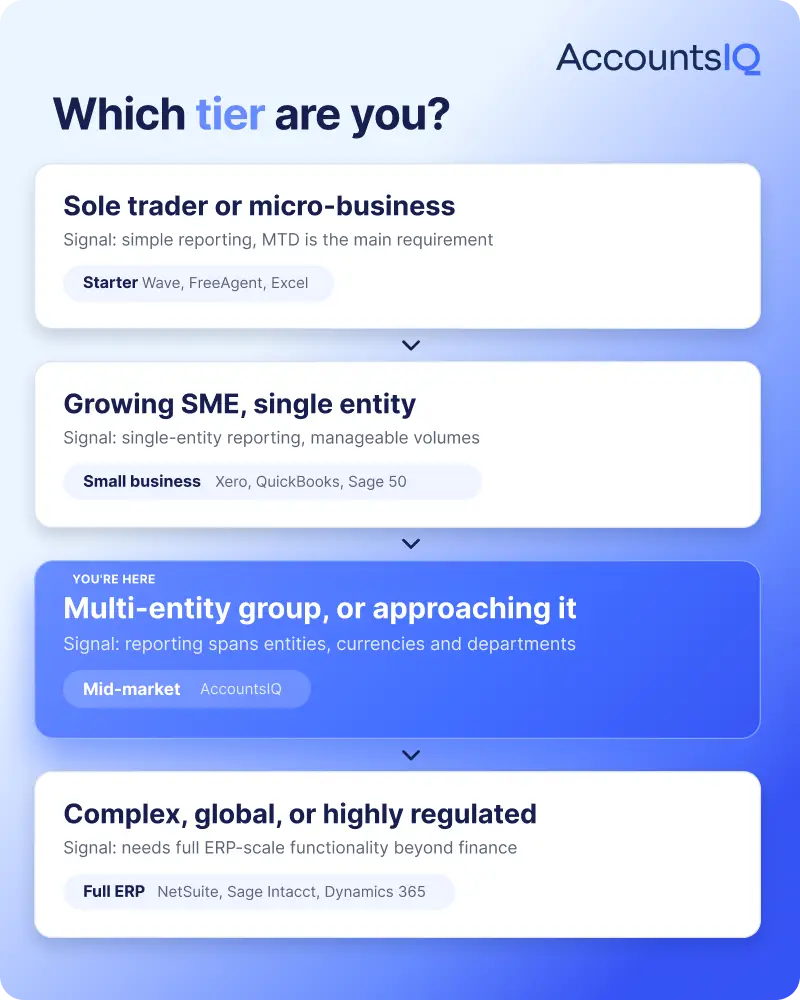
Sole traders and micro businesses: Simple, and MTD-ready
At this end of the market, the job is straightforward:
- Invoicing
- Basic expense tracking
- A route through Self-Assessment that doesn't eat your evenings
The one thing that has changed the calculation for a lot of sole traders and landlords is Making Tax Digital for Income Tax.
From 6 April 2026, anyone with qualifying income over £50,000 from self-employment or property needs MTD-compatible software, keeping digital records and sending quarterly updates instead of one annual return. The threshold drops to £30,000 in April 2027 and £20,000 in April 2028, so this catches a growing number of people over the next few years.
If you're anywhere near those thresholds, check your software is on HMRC's recognised list before you commit to it. Getting this right now is a lot less painful than switching mid-way through a tax year.
Small businesses: Xero, QuickBooks, and Sage territory
Once you take on staff, register for VAT, and start running payroll, Xero, QuickBooks, and Sage 50 are the products doing most of the heavy lifting in the UK small business market.
All three handle:
- Invoicing
- VAT
- Standard reporting
And all three are HMRC-recognised for MTD.
Where they start to feel the strain is reporting depth and structure. A single trading entity with straightforward operations rarely runs into trouble. Add a second entity, a second currency, or a board that wants numbers cut by department, project, or location, and you start seeing exports, pivot tables, and someone quietly rebuilding the same report every month.
None of that is a criticism of the products. It's simply not the problem they were built to solve.
Mid-sized and multi-entity groups: Group power without ERP overhead
This is the gap AccountsIQ is built for. Finance teams here have usually outgrown basic bookkeeping tools, but a full ERP rollout would mean paying for, and configuring, operational scope they don't need.
AccountsIQ gives finance teams native, automated consolidation, intercompany eliminations, multi-currency accounting, and real-time group reporting, without turning the finance system into a wider ERP project.
- Automated consolidation across multiple entities, without manual eliminations in a spreadsheet
- Multi-currency accounting for groups trading in more than one currency
- Approval workflows and audit trails that sit with the transaction, not in an email thread
- Business intelligence dashboards and an open API for the rest of your finance stack
Keep in mind: if your finance process is still one entity, simple bookkeeping and light reporting, AccountsIQ is likely more than you need for now. It's built for the reporting and consolidation pressure that comes with growth, not for replacing invoicing software at a single-entity small business.
💡 Book a demo and see how AccountsIQ can simplify consolidation and group reporting without the ERP overhead.
Large and complex operations: When you genuinely need an ERP
NetSuite, Sage Intacct, and Microsoft Dynamics 365 Business Central sit at the ERP end of the market.
They can be the right call when finance needs to sit inside a much wider operational system, covering areas like inventory, procurement, CRM, or supply chain alongside the ledger.
The honest test is whether you need that operational breadth, not just deeper accounting.
- If the priority is finance, reporting, consolidation, and control, a finance-first platform can deliver that depth without the cost, timeline, and configuration overhead of a full ERP rollout.
- If the business genuinely needs inventory, procurement and finance running in one system, that's a different conversation, and ERP is worth the investment.
The signs you've outgrown Xero or QuickBooks
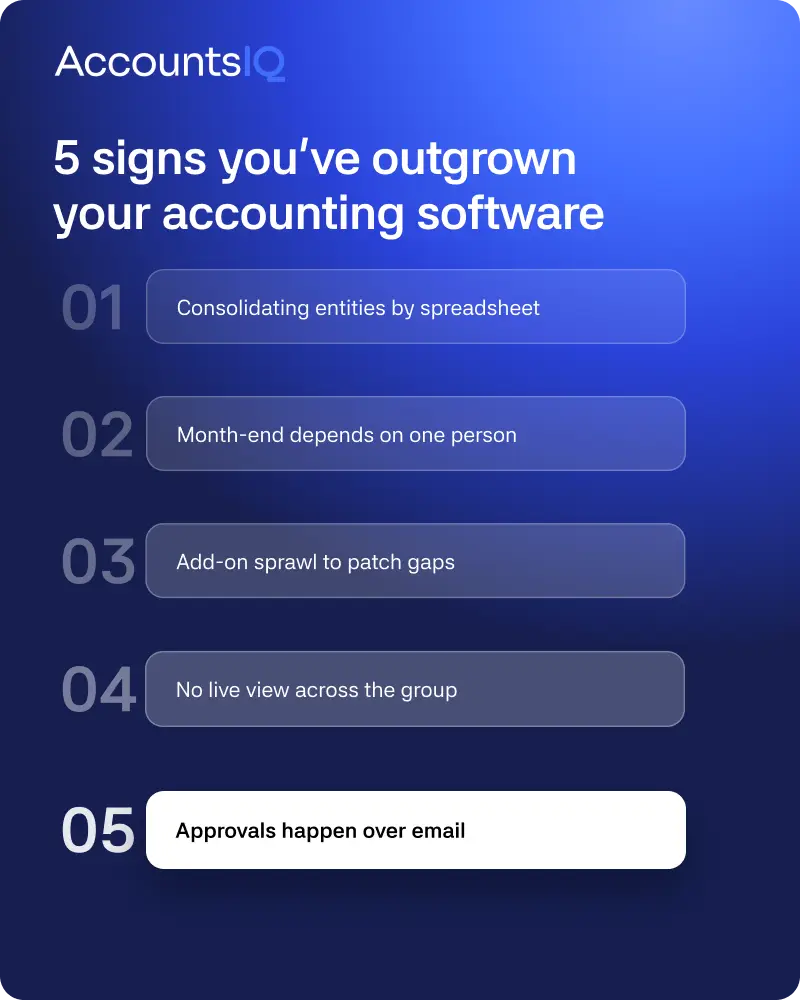
These signs tend to show up gradually, which is exactly why they're easy to miss until month-end starts costing more time than it saves.
- Consolidating entities by spreadsheet, with manual eliminations rebuilt every period
- Month-end that depends on one person's exports, and slips whenever they're on leave
- Add-on sprawl: a patchwork of extra tools bolted on to cover gaps in reporting or approvals
- No live view across the group, so the board pack is always a snapshot of last week, not today
- Approvals happening over email rather than sitting with the transaction and its audit trail
None of these are dramatic on their own. Together, they're usually the clearest signal that the accounting software is costing the team more time than it's saving.
The features that actually change your month-end
It's easy to compare software on feature count. It's more useful to judge features by what they actually do to your close.
What UK accounting software really costs
Pricing works differently across the four tiers, and none of it is fixed enough to quote as a firm figure here. As a rule of thumb:
- Micro and small business tools are typically priced per user, per month, as standard SaaS subscriptions.
- Mid-market platforms are usually priced per entity or by quote, reflecting the reporting and consolidation scope you need.
- Full ERP platforms are almost always quote-based, and the licence cost is only one part of the total, alongside implementation, configuration, and training.
But the licence fee is rarely the whole story.
Implementation, data migration, training, add-ons, and future configuration all add up, and a system that looks cheaper up front can cost more over two or three years if it needs constant manual workarounds to do the job.
Staying compliant: MTD, VAT, and data security
Whatever tier you're in, three compliance areas are worth checking before you commit to any platform.
Making Tax Digital
MTD for VAT has applied for some time. MTD for Income Tax Self Assessment starts on 6 April 2026 for qualifying income over £50,000, dropping to £30,000 in 2027 and £20,000 in 2028.
Any software you choose needs to be on HMRC's recognised software list for the obligations that apply to you.
Audit and reporting thresholds
Company size thresholds under the Companies Act 2006 determine whether audit exemptions and abridged reporting apply.
As a group grows toward, or past, those thresholds, reporting and consolidation needs typically change well before the audit requirement itself kicks in, which is often the point where a mid-market platform starts to make sense.
Data security
UK GDPR and general data protection obligations apply to any system holding financial and personal data.
Check where data is hosted, who can access it, and how permissions and audit trails are managed before you migrate anything across.
How to switch without wrecking your close
A software switch goes wrong far more often because of timing and process than because of the product itself. A practical migration path looks like this:
- Export and reconcile your existing data first, rather than migrating and checking afterwards.
- Run the new system in parallel with the old one for at least one full reporting cycle before switching over completely.
- Time the cutover around month-end or year-end, not in the middle of it. Moving mid-cycle is one of the most common causes of a messy first close.
- Confirm what training and support is included, and who owns data migration, before you sign anything.
A new system should remove manual work, not recreate it somewhere else.
If a vendor can't show you clearly how your specific reporting structure would work in their platform, that's worth treating as a warning sign rather than a detail to sort out later.
Choosing the tier that actually fits
The right accounting software is the one that matches the finance function you're running now, and the one you're likely to be running in two years.
Starter tools are genuinely good at what they do. Full ERP is right for businesses with real operational breadth. Most growing UK finance teams sit somewhere in between, needing group reporting and consolidation without ERP-level complexity.
If spreadsheets are still doing your consolidation, or month-end depends on one person's exports, it's worth seeing what a mid-market system would look like for your group.
💡 Book a demo to see how AccountsIQ handles group reporting, consolidation, and multi-entity control for growing finance teams.
Frequently asked questions
What is the best accounting software for a small business in the UK?
For most small UK businesses, Xero, QuickBooks or Sage 50 cover invoicing, bank reconciliation, VAT, and standard reporting well. The right one usually comes down to which your accountant or bookkeeper already uses, and how important built-in payroll is to you.
What is the best accounting software for multiple entities or group consolidation?
Multi-entity groups generally need software built for consolidation, not a small business tool with an add-on bolted on. AccountsIQ is built specifically for automated consolidation, intercompany eliminations and multi-entity reporting.
When should you move from Xero or QuickBooks to a mid-market system?
The clearest signals are consolidating entities by spreadsheet, a month-end that depends on one person's manual process, no live view across the group, and a board that needs reporting the current system can't produce without rebuilding it by hand.
Do I need a full ERP, or is mid-market accounting software enough?
That depends on whether finance needs to sit inside wider operational systems such as inventory, procurement or CRM. If the priority is finance, reporting, consolidation and control, a finance-first mid-market platform usually gives you that depth without the cost and timeline of a full ERP rollout.
Does UK accounting software have to be Making Tax Digital compliant?
If you're VAT-registered, MTD for VAT already applies. If you're self-employed or a landlord with qualifying income over £50,000, MTD for Income Tax applies from 6 April 2026, with the threshold falling in the following two years. Always check a platform is on HMRC's recognised software list for the obligations that apply to your business.